From accelerating drug development pipelines to advancing autonomous vehicle performance and strengthening financial security, AI is driving paradigm shifts across industries. As AI rapidly reshapes daily life across work, education, homelife and travel, understanding this changing ecosystem is essential for navigating the AI era. To shed light on this, the SK hynix Newsroom is kicking off a new series, “Exploring the AI Ecosystem.”
AI Ecosystem
AI, a concept first widely introduced in the 1950s, struggled to advance for several decades. Despite the best efforts of pioneering scientists, the field experienced periods of stagnation known as AI winters, driven by inadequate computing infrastructure, underdeveloped logical frameworks, and a lack of data. However, the resurgence of machine learning1 in the 1990s sparked significant advancements in the field of AI.
1Machine learning: A subset of AI which enables systems to autonomously discover and learn patterns or rules directly from data, including online resources.
In 2006, Geoffrey Hinton — often regarded as the “godfather of AI” — proposed a theory for training artificial neural networks more effectively. His work revived interest in deep learning2, which has gone on to become the defining algorithm of AI. In the 2010s, the advent of graphics processing units (GPUs) capable of running massively parallel computations like a human brain marked a turning point. Coupled with the explosive growth of data driven by advances in network infrastructure, this development proved a catalyst for AI training and development. After years of technological breakthroughs, AI evolved into generative AI3 (GenAI) by the 2020s. Powered by advanced architectures such as Large Language Models4 (LLMs), this new wave of AI has expanded into a growing ecosystem that is reshaping industries and human interaction on an unprecedented scale.
2Deep learning: A flagship algorithm of AI which mimics the human brain by using multi-layered neural networks to process and learn from vast amounts of data.
3Generative AI (GenAI): A class of AI models that can generate new, original content based on patterns in the training data.
4Large Language Models (LLMs): AI models that power generative AI by leveraging vast datasets and advanced architectures to create human-like text, images, and other content, revolutionizing communication and creativity.
Amid these discussions about AI’s evolution and expansion, a central question emerges: What is the AI ecosystem? Broadly speaking, the term “AI ecosystem” refers to the industrial and social structures formed by a network of companies, governments, educational institutes, and users involved in every stage of AI — from development and application to infrastructure, policies, and regulations. Views of this AI ecosystem can vary depending on the perspective of the relevant country, industry, technology, or stakeholder. This series aims to provide a comprehensive view of the AI ecosystem through the lens of the AI value chain, examining how each layer contributes to its evolution.
Five Areas of the AI Ecosystem
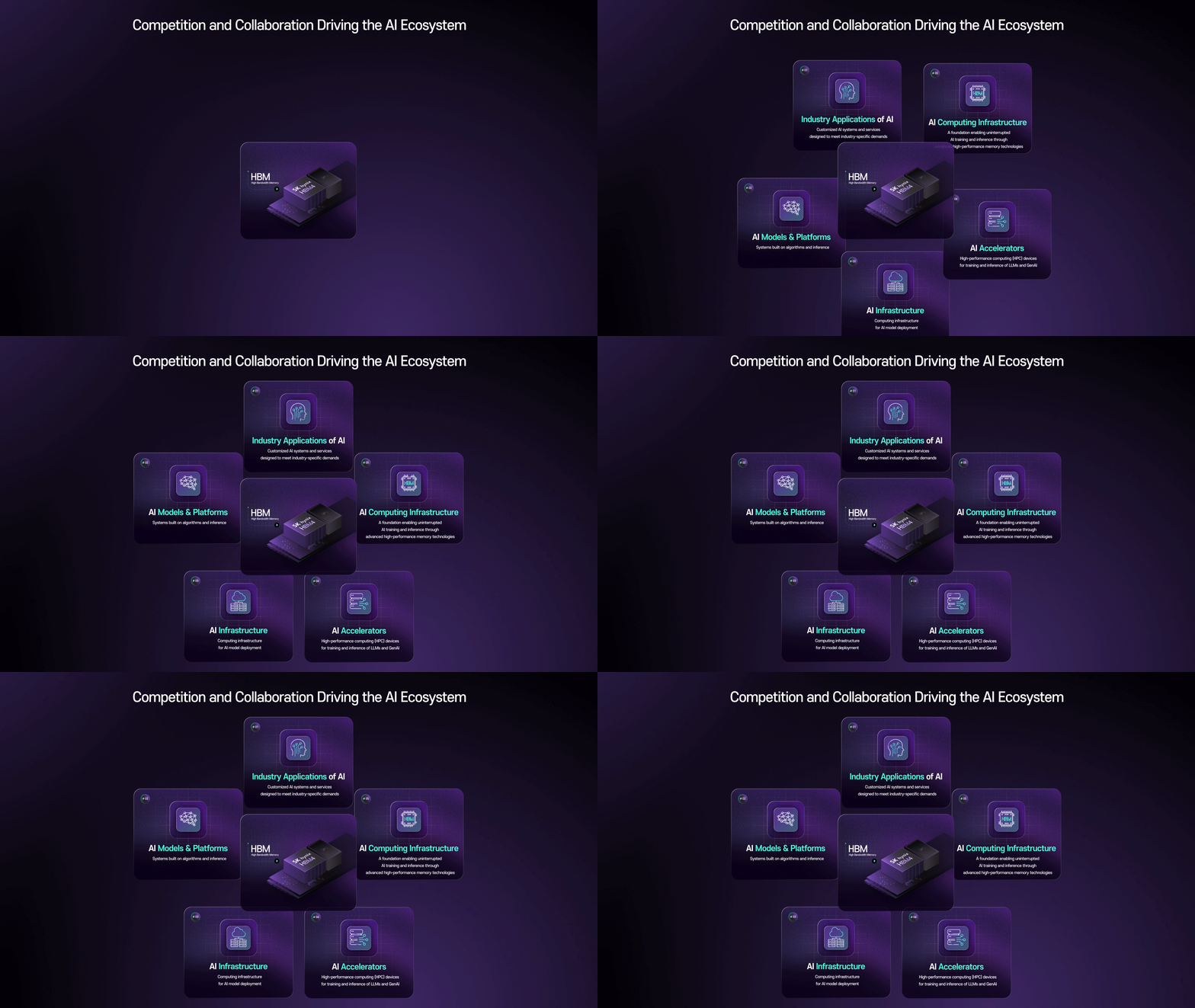
The AI ecosystem can generally be categorized into five main areas:
- Industry applications of AI: The adoption of AI across various industries.
- AI models and platforms: Systems enabling the development and deployment of AI-driven industrial applications.
- AI infrastructure: The foundational technology that supports the operation of AI models.
- AI accelerators: Hardware delivering the core computational power for high-performance AI tasks.
- AI computing infrastructure: The advanced computational frameworks that enable complex AI operations.
Among these, AI computing infrastructure serves as both the foundation and starting point of the entire AI ecosystem. As a global leader in developing and delivering world-class AI memory solutions, SK hynix plays a pivotal role in advancing this AI computing infrastructure and fostering the growth of the broader AI ecosystem.

1. Industry Applications of AI
The adoption and expansion of AI across industries involves the tailored application of AI technologies to address specific needs in fields such as manufacturing, retail, finance, healthcare, and the public sector. Tasks that previously demanded significant human oversight and long hours are now handled by AI with greater speed and efficiency, dramatically enhancing productivity and effectiveness. For instance, digital twins5 are used in the manufacturing industry to provide real-time simulations of factory operations. This makes it possible to predict and address issues in advance as well as maximize manufacturing efficiency through AI-based production automation, quality control, and maintenance. Many tech companies such as Microsoft, Google, Salesforce, Palantir, and Oracle offer industry-specific AI solutions. For example, Microsoft provided BMW Group with a data delivery solution that harnessed the Microsoft Azure cloud computing platform. Leveraging the solution and Internet of Things (IoT) technologies, BMW Group achieved a tenfold improvement in data delivery efficiency which significantly enhanced the effectiveness of new vehicle development.
5Digital twin: A digital replica model that replicates real-world objects or systems in a virtual space. This enables real-time data collection and analysis of the environments, supporting forecasting and operational optimization.
2. AI Models & Platforms
Industry applications of AI are enabled by AI models and platforms such as GenAI and LLMs, which are now widely used. GenAI generates content such as text, images, and videos in response to user prompts. Meanwhile, LLMs are advanced language models trained on vast datasets which power many of these GenAI functions by enabling tasks such as text generation, summarization, and translation. Notable examples of AI models include OpenAI’s ChatGPT, Google DeepMind’s Gemini, Meta’s Llama, and Anthropic’s Claude. As AI models and platforms serve as both the foundation for industrial applications and catalysts for innovation, their continued evolution will remain critical going forward.
3. AI Infrastructure
AI models and platforms must perform complex computational tasks based on large volumes of data. For example, OpenAI’s GPT-4 model is estimated to have more than one trillion parameters. Rapidly processing such large volumes of data requires an enormous network of infrastructure.
AI infrastructure encompasses the data centers, cloud services, networks, hosting environment, software and APIs6 needed for AI computation and the operation of AI models. Key providers include Amazon Web Services (AWS), Microsoft Azure, and Google Cloud. To ensure secure and efficient data storage while addressing the challenges of skyrocketing power consumption, continuous innovation in AI infrastructure is necessary for achieving sustainability.
6Application programming interface (API): A set of protocols that allows different software applications to communicate and share functionality seamlessly.
4. AI Accelerators
One of the key components of AI infrastructure is AI accelerators, most notably GPUs. Unlike Central Processing Units (CPUs) which process instructions sequentially, GPUs are specialized for parallel processing. Initially designed for graphics processing in gaming, GPUs are now applied in machine learning and deep learning workloads in AI development and play a crucial role in the AI ecosystem. Current developers include NVIDIA (H100, H200, B100, B200 Tensor Core GPU), AMD (Instinct MI300, MI350 GPU), and Intel (Gaudi2, Gaudi3 series).
GPUs are essential for AI development and operations, serving as accelerators for the training and inference of LLMs. Their importance has sparked a global shortage of GPUs as companies intensely compete to secure supply.

5. AI Computing Infrastructure
AI computing infrastructure serves as the foundation for AI accelerators such as GPUs to perform high-performance computations. At the core of this infrastructure is HBM7, which supports seamless AI model training and inference by providing a high-speed computational environment. As AI technologies advance and GPUs continue to evolve, HBM has grown rapidly to become an essential component of the AI ecosystem.
7High Bandwidth Memory (HBM): A high-value, high-performance product featuring vertically stacked DRAM chips that significantly enhances data processing speeds compared to conventional DRAM.
SK hynix is a global leader in the HBM market. Building on its historic achievement of developing the world’s first HBM product in 2013, the company reached another milestone in March 2025 by becoming the first to deliver 12-layer HBM4 samples to major customers. As the saying in the AI industry goes, “There is no AI without HBM.” Today, HBM serves as a critical engine driving the AI ecosystem forward.
Fueling Innovation Through Collaboration and Competition
As shown above, the AI ecosystem follows a linear progression spanning industry applications of AI; AI models and platforms; AI infrastructure; AI accelerators; and AI computing infrastructure. At the same time, the ecosystem is interconnected through overlapping value chains where numerous tech companies operate across multiple domains. Notably, these companies must collaborate as the complexity and scale of AI make it impossible for any single entity or technology to maintain the ecosystem alone. Connectivity and collaboration are therefore essential to sustain and grow this vast ecosystem.
While collaboration is essential, rivalry and technological competition in AI continue to make the headlines. As AI technology accelerates rapidly and related markets experience unprecedented growth, governments and tech companies worldwide are racing to invest in AI and drive innovation through its applications. In August 2025, the South Korean government announced a KRW 100 trillion (USD 72 billion) investment program to become one of the world’s top three AI powerhouses. Amid these developments, the technologies and strategies of AI leaders such as SK hynix are poised to significantly shape the broader AI industry ecosystem.
The next installment of the series will explore SK hynix’s role and leadership within the AI ecosystem.