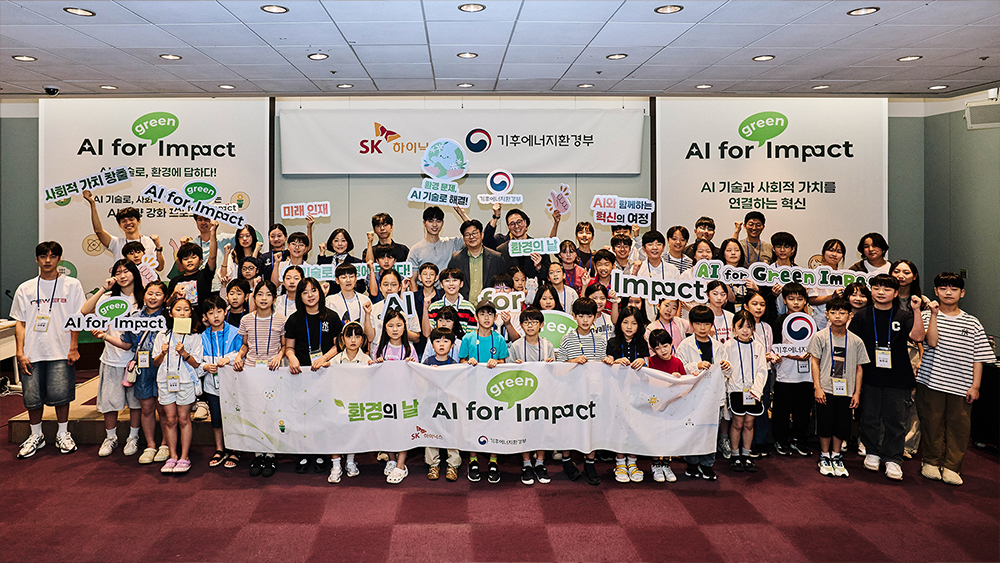
▲ Guests and participants at the AI for Green Impact event
On June 5, World Environment Day SK hynix co-organized ‘AI for Green Impact,’ a hands-on educational program jointly hosted with the Ministry of Climate, Energy and Environment. The event took place at the Conference Hall on the third floor of COEX in Seoul. Approximately 100 participants — elementary, middle, and high school students and their families — spent the day exploring environmental challenges and devising solutions through AI technology, stepping into the role of ‘AI environmental scientists.’ The enthusiasm of the children, whose eyes sparkled with curiosity throughout the lectures, inspired hope that this day’s experience would go beyond a simple activity and carry forward into real climate action by the next generation.
“Addressing the Climate Crisis Is a Challenge We Must All Solve Together”
The event opened with a video presentation. The film depicted the realities of the climate crisis alongside efforts by various sectors to address environmental issues through technology, highlighting the importance of everyday actions for the planet.
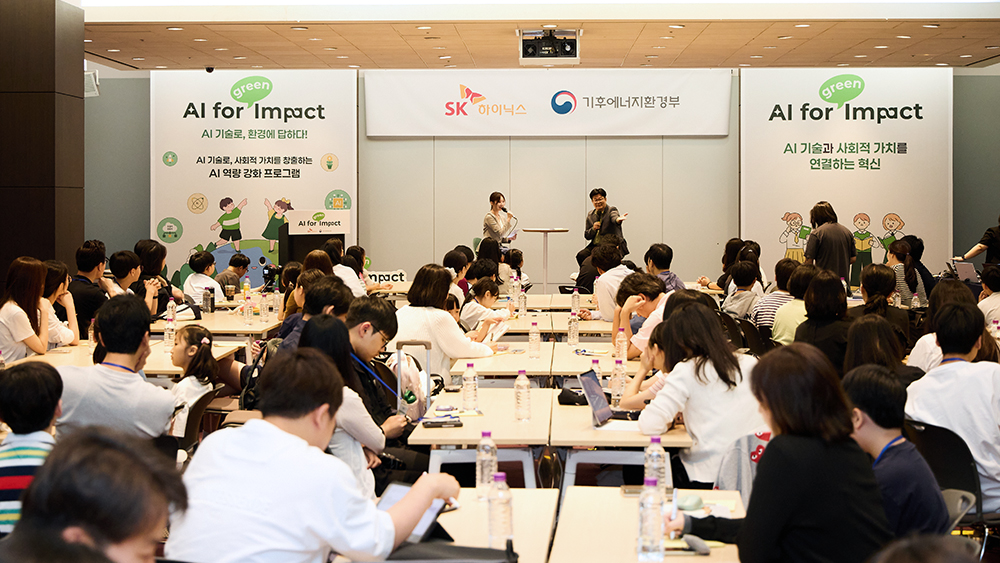
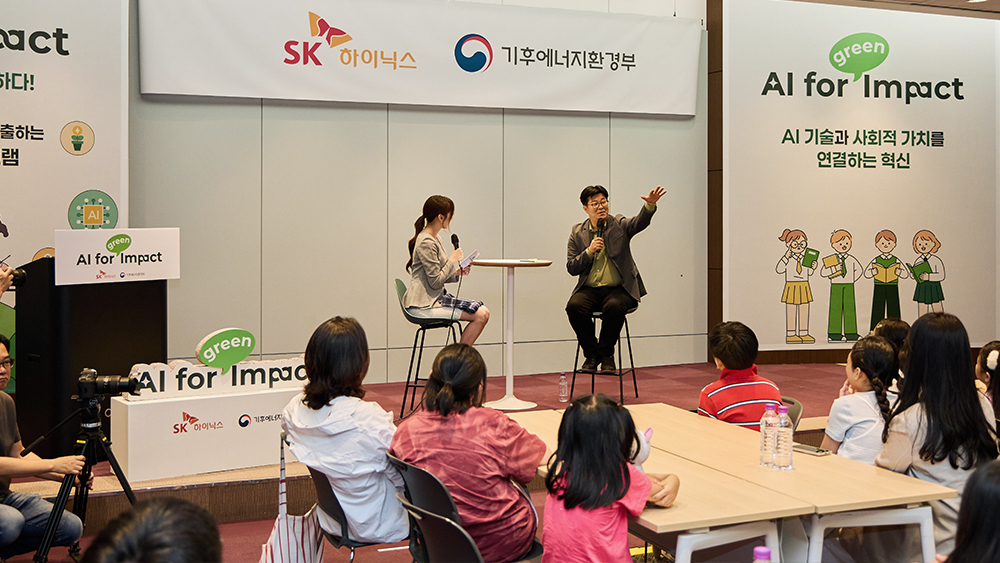
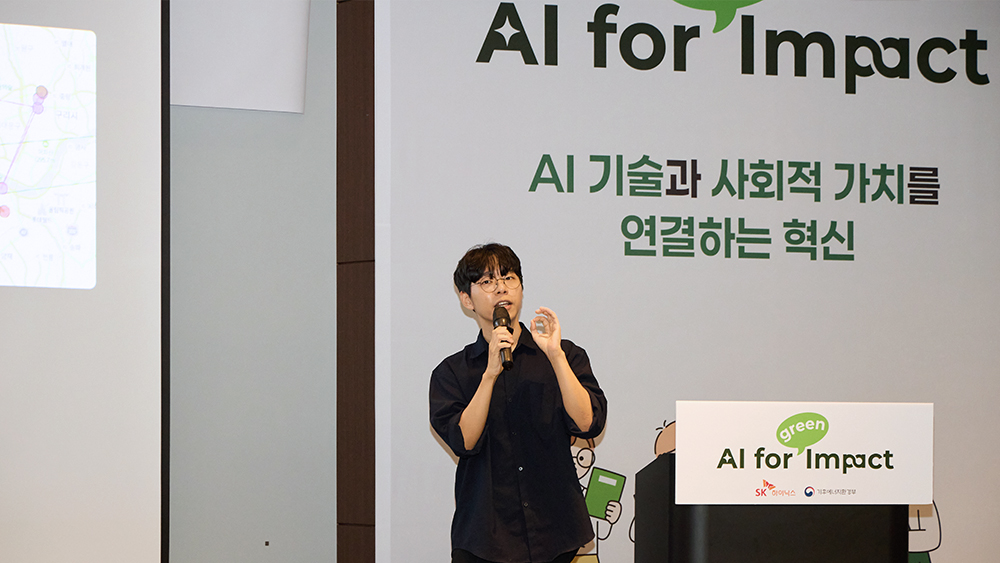
This was followed by an environmental education session led by Professor Jaeseung Jeong, Professor of Brain and Cognitive Sciences and Dean of the School of Transdisciplinary Studies at KAIST. A neuroscientist and physicist, Professor Jeong is widely known for making science accessible and engaging to the public — through his public lectures and writing — by explaining AI and the many scientific factors that shape our daily lives in plain, approachable language.
During the lecture, Professor Jeong began by examining the context of the climate crisis from the perspective of the Big History of the 13.8-billion-year-old universe. He then introduced the major environmental issues currently affecting our daily lives in a way tailored to young audiences. He went on to explain the various efforts made so far to address these issues, before exploring in detail how applying AI technology could transform the process of finding solutions.
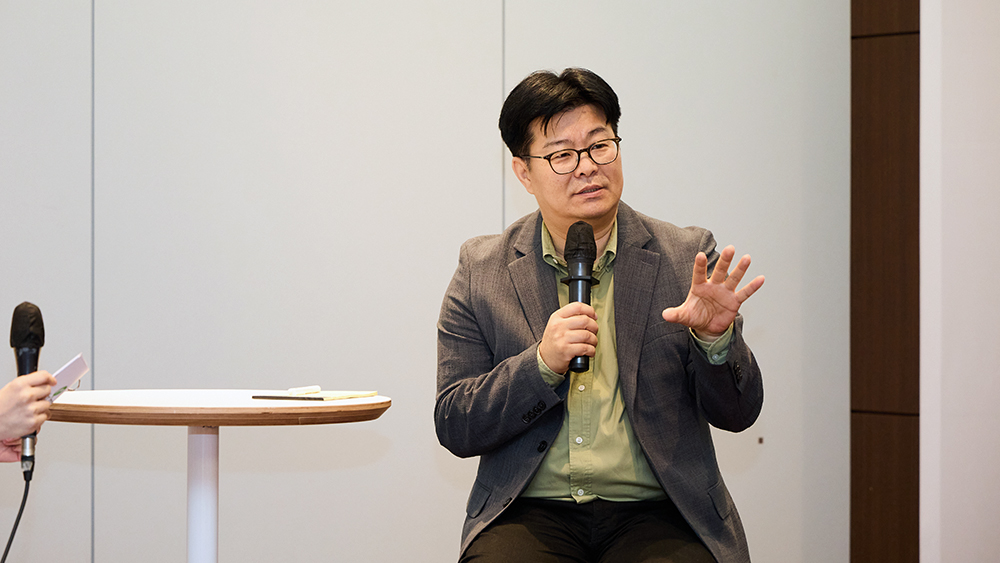
Professor Jeong encouraged participants, saying: “Environmental issues such as unseasonably hot weather and fine dust not only impair our judgment by negatively affecting the human brain, but also have a significant impact on mental health by exposing us to prolonged stress and increasing the risk of depression. I look forward to seeing your generation — for whom AI will be as natural as breathing — harness it to discover the decisive solutions that will save our planet.”
Coding, Analyzing, and Creating, Using AI to Explore Solutions to Environmental Issues
In the afternoon, hands-on AI education sessions were held in collaboration with professional AI instructors. Participants were divided into three classes based on their interests, applying their individual strengths and talents to think creatively about solutions to environmental challenges.
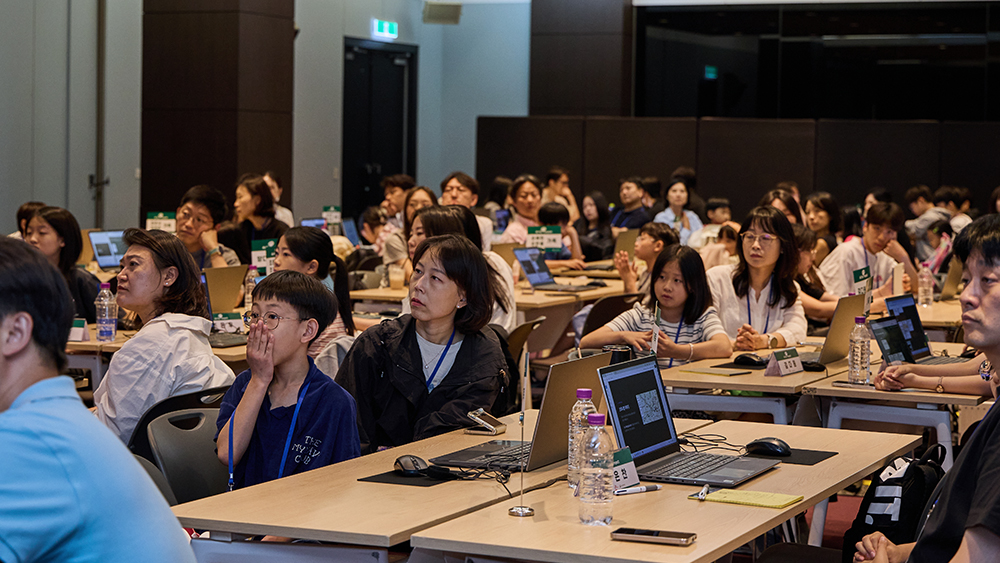
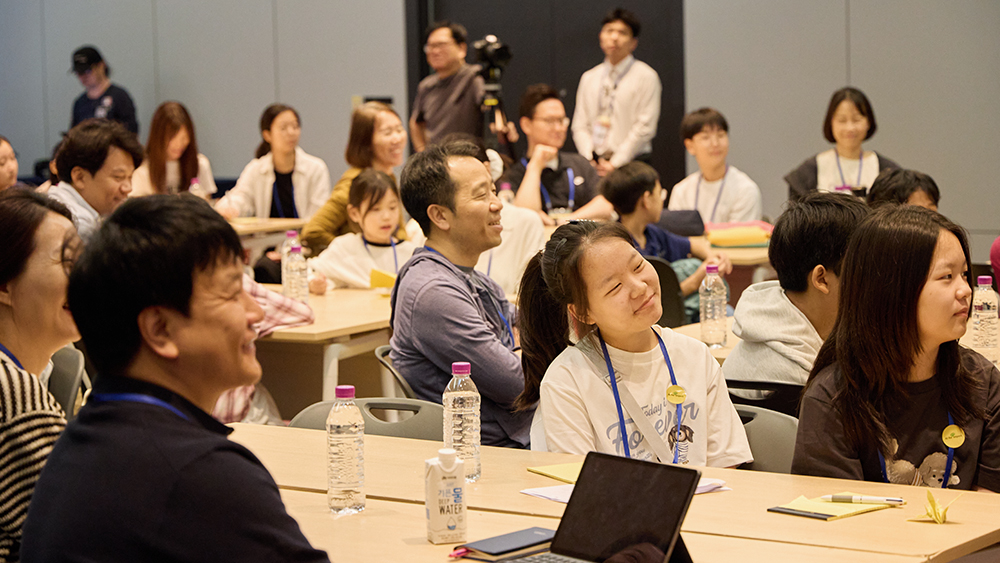
The first class, themed “Protecting the Earth with Climate Data,” was led by Donghoon Lee, CEO of LinkWisdom and widely recognized as the developer of the COVID-19 contact tracing app. Lee introduced coding methods for developing climate crisis-related applications, and participants wrote their own code to build apps, nurturing their dreams of becoming future creators of environmental tools.
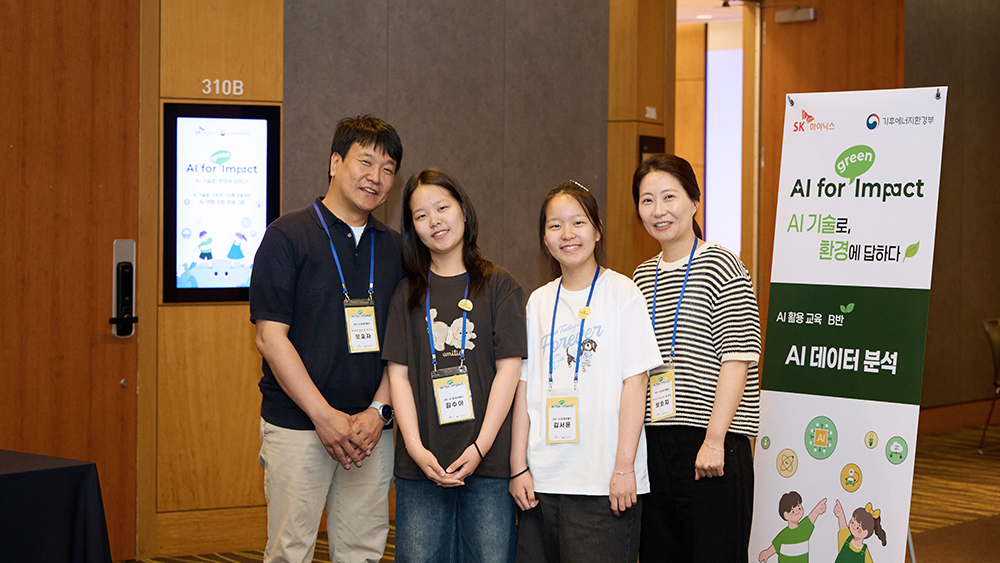
▲ Seoyun Kim (second from right) and Sua Kim (second from left) of Incheon Cho-eun Elementary School, who took part in the day’s educational program
The second class, titled “AI Environment/Energy Master,” focused on using AI agents to collaboratively analyze a range of environment-related data. Seoyun Kim and Sua Kim (Incheon Cho-eun Elementary School), participants who analyzed ecological monitoring data collected near the SK hynix Yongin cluster using AI, shared their enthusiasm: “It was truly fascinating to watch the data on the screen get organized in a clear, at-a-glance format and have only the relevant information extracted with such precision. This experience made my dream of becoming a data scientist — someone who provides a solid evidence base for environmental advocates — even clearer,” they said with a bright smile.
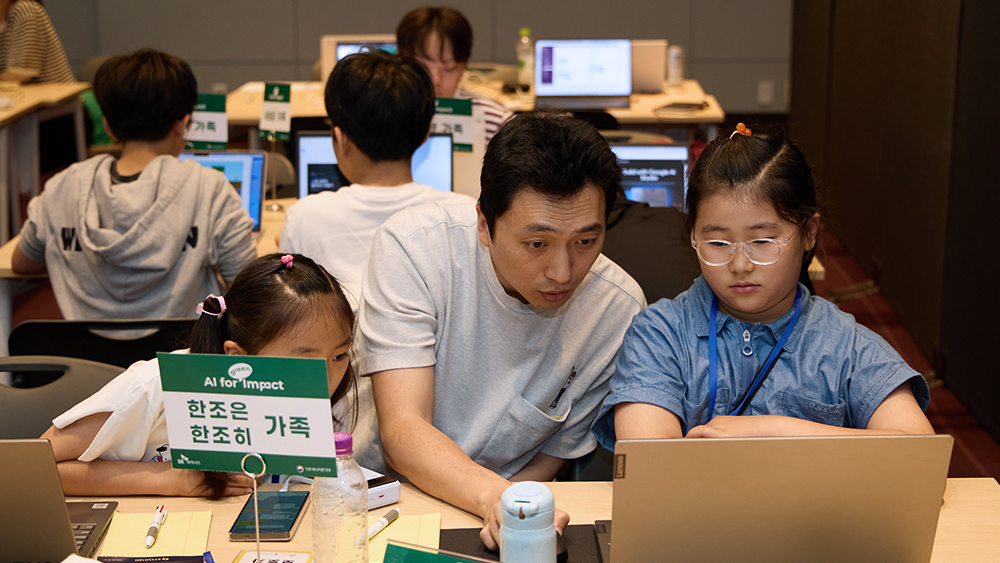
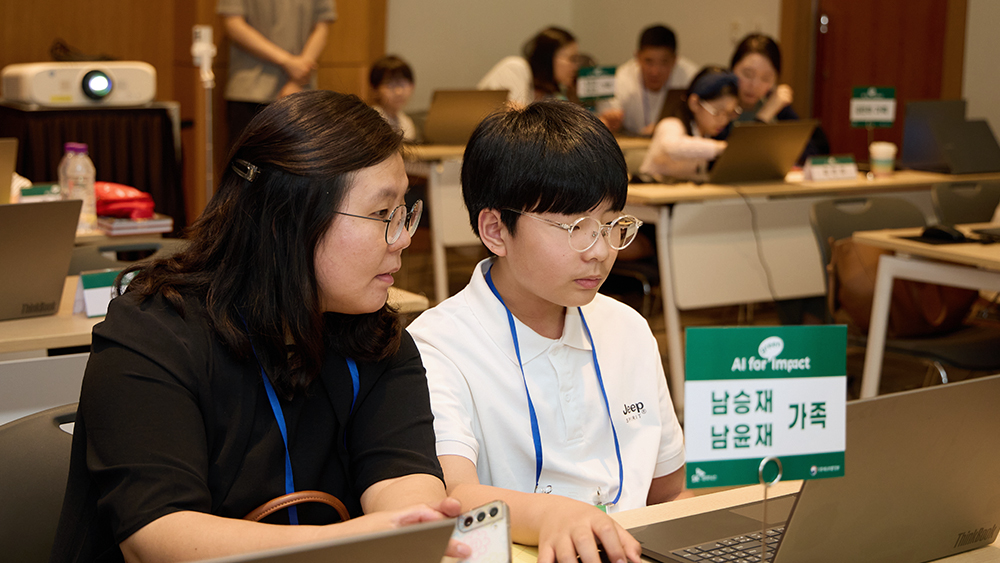
The third class, themed “Big History of the Climate Crisis,” gave participants the opportunity to create their own environmental content using AI tools. The heartwarming sight of families — parents and children sitting side by side, crafting videos, storybooks, and posters with AI — perfectly captured the spirit of this event: generations coming together to think about climate challenges.
After the sessions, participants received certificates of completion and commemorative gifts, and the event concluded with everyone reflecting once more on the significance of World Environment Day.
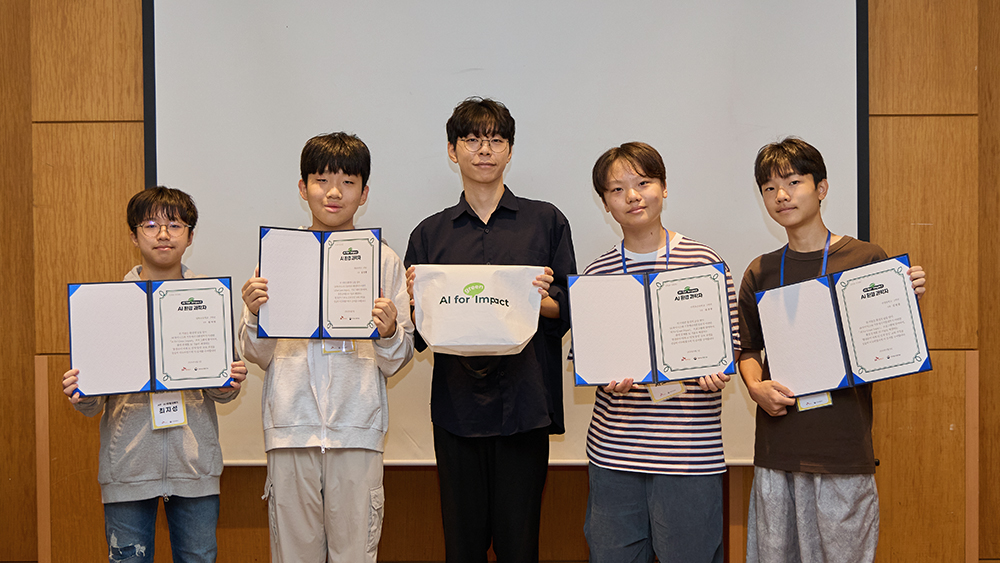
▲ Participants and Donghoon Lee, CEO of LinkWisdom, posing for a commemorative photo after receiving their AI for Green Impact certificates of completion
SK hynix plans to ensure that the outcomes of this event do not remain as a one-time educational experience, but evolve into best practices for addressing environmental issues through AI. Specifically, outstanding cases identified during the event will be supported through one-on-one mentoring sessions with AI experts from June through August, and the results will be presented at the “Korea Social Value Festa” in September.
SK hynix noted, “This ‘AI for Green Impact’ event represents a meaningful step in extending the AI capacity-building expertise developed through our existing AI for Impact program — originally targeted at social enterprises and citizen scientists — to the next generation. We plan to continue scaling up the program to ensure that participants’ ideas translate into tangible change.”