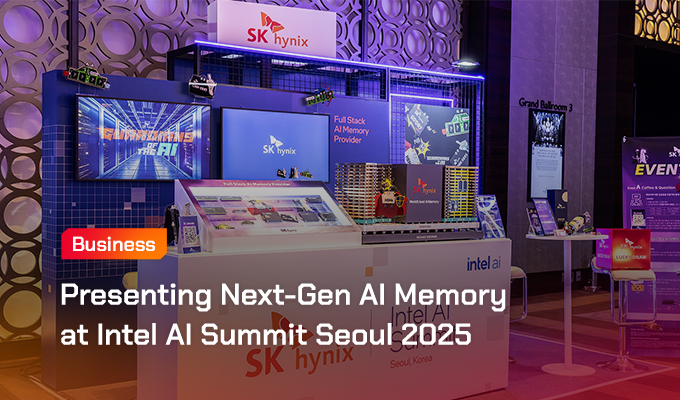
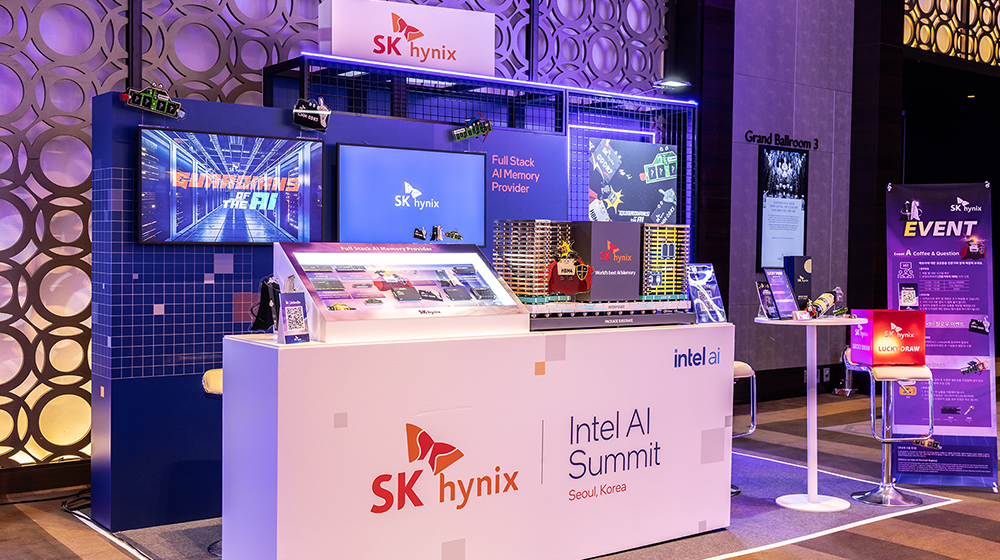
SK hynix showcased its groundbreaking memory solutions for high-performance AI servers and storage systems at Intel AI Summit Seoul 2025 on July 1, demonstrating its global industry leadership.
The Intel AI Summit events are held throughout the year by Intel in 24 major cities worldwide, providing a platform for discussions on the potential and future strategies of the AI industry. This year’s summit in Seoul focused on the latest trends in AI technology and innovative application cases while also exploring the future direction of AI development across industries.
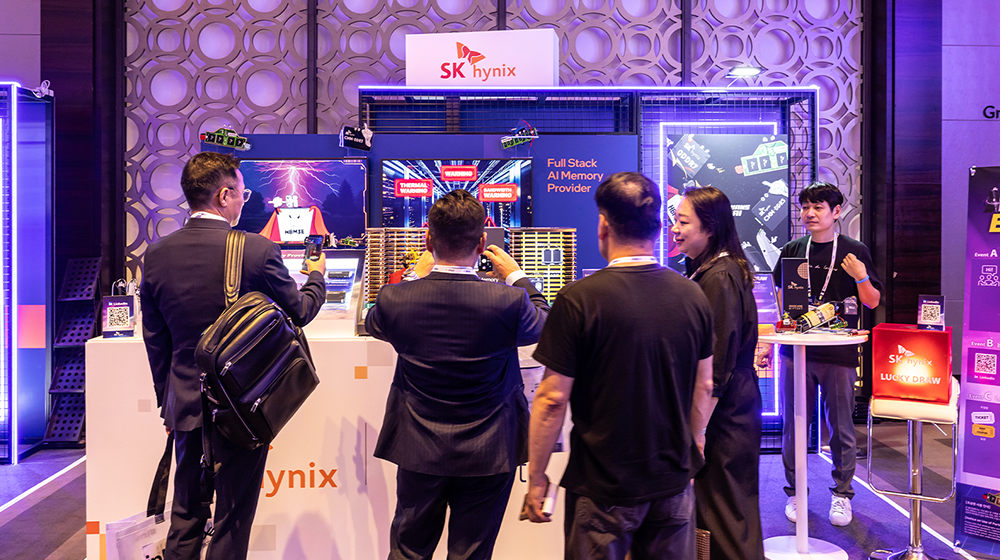
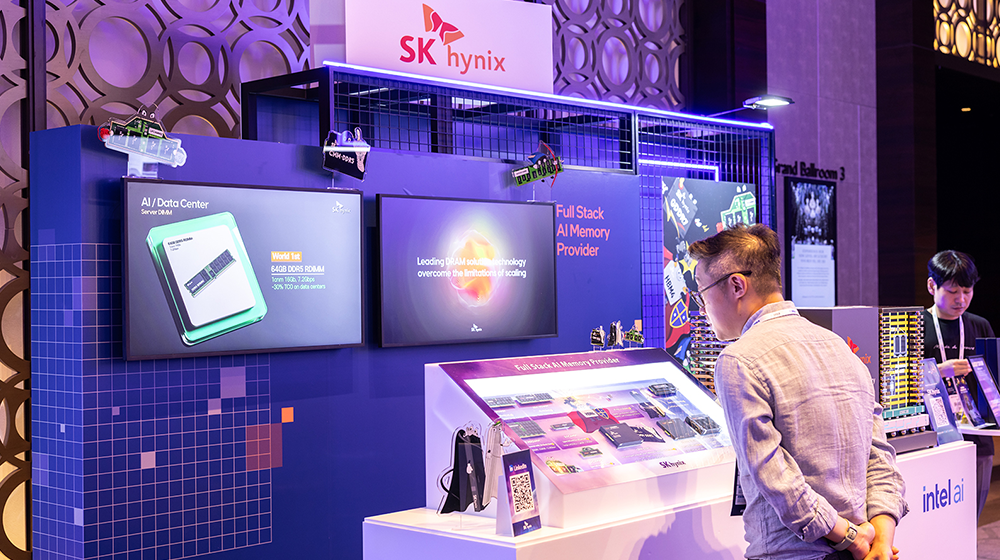
Visitors to SK hynix’s booth learning about the company’s industry-leading memory solutions
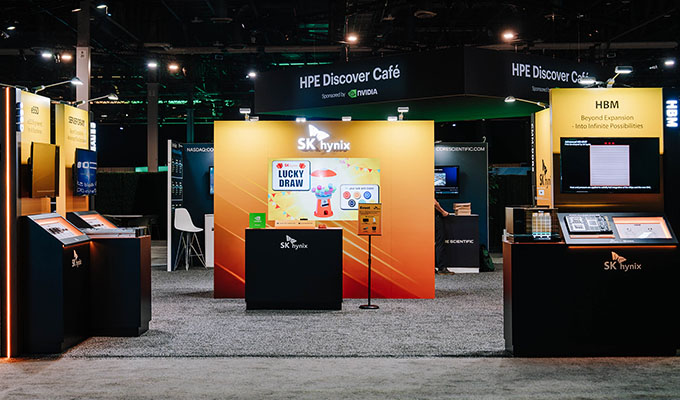
At its exhibition booth, operated under the theme “Full Stack AI Memory Provider,” SK hynix highlighted its memory products and technologies that will lead AI innovation. The booth’s eye-catching design, featuring unique characters, conveyed the company’s diverse portfolio of industry-leading products in a more approachable manner for visitors.
Presenting Innovative AI Memory Products
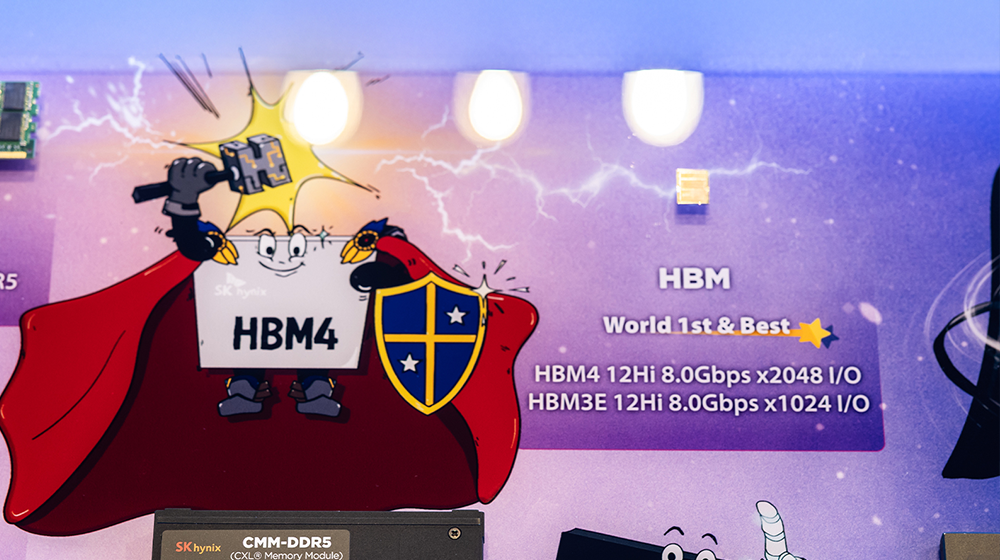
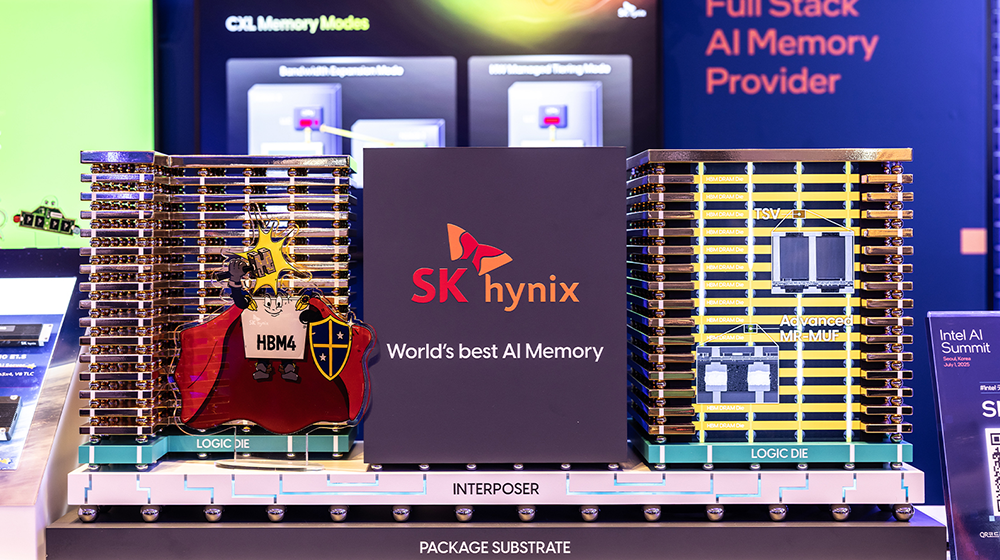
A model of SK hynix’s HBM and related technologies
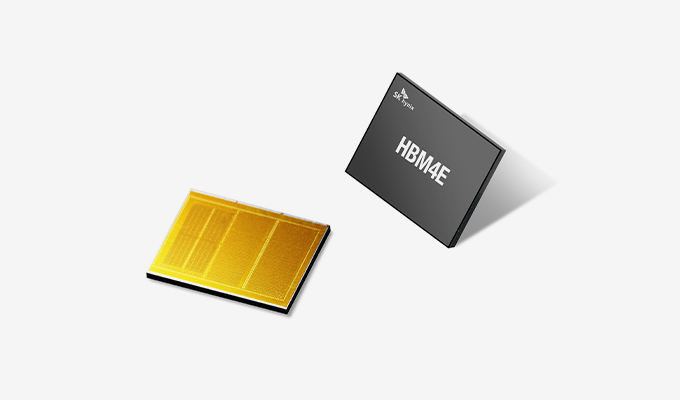
At the event, SK hynix showcased its 12-layer HBM4, capable of processing more than 2 terabytes (TB) of data per second, and its 12-layer HBM3E, the industry’s highest-capacity HBM1 product available on the market to date at 36 GB. The company recently became the first in the industry to supply existing major customers with samples of its 12-layer HBM4, which delivers the world-class speed required for AI memory. Most notably, SK hynix exhibited a 3D model that helped visitors better understand the technologies used in HBM, such as TSV2 and Advanced MR-MUF3, drawing significant attention and reaffirming its technological leadership.
1High Bandwidth Memory (HBM): A high-value, high-performance product that significantly enhances data processing speeds compared to conventional DRAM by vertically stacking multiple DRAM chips. There are six generations of HBM, starting with the original HBM and followed by HBM2, HBM2E, HBM3, HBM3E, and HBM4.
2Through-silicon via (TSV): A technology that drills thousands of micro-holes in DRAM chips to vertically connect the holes of upper and lower chips with electrodes.
3Advanced mass reflow-molded underfill (Advanced MR-MUF): A next-generation MR-MUF technology that incorporates warpage control, allowing chips which are 40% thinner than conventional chips to be stacked without warping. Additionally, the use of a new protective material improves heat dissipation.
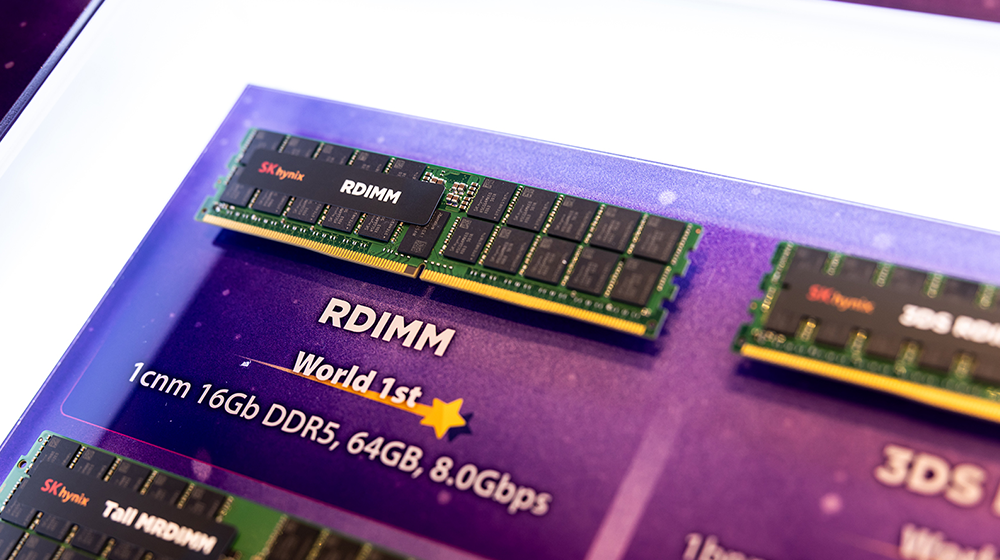
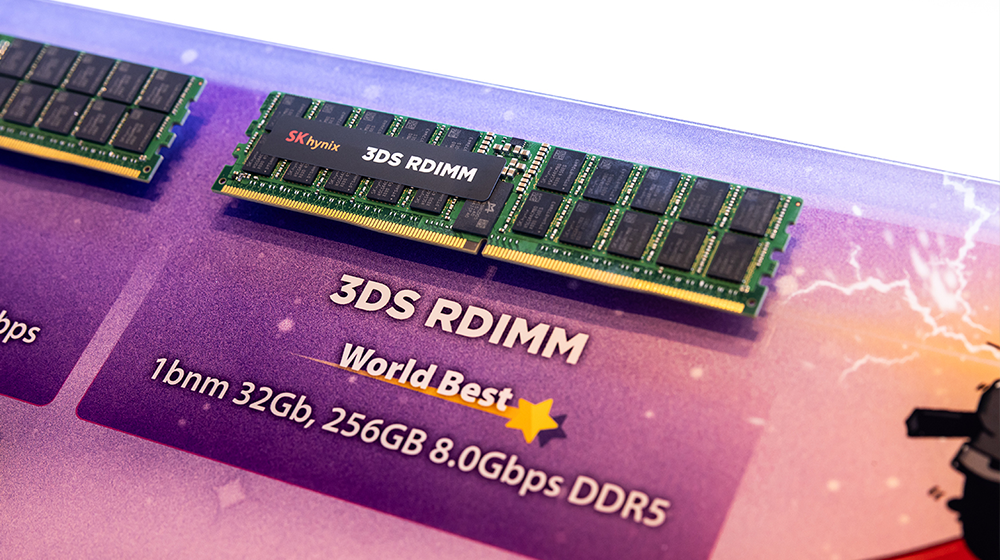
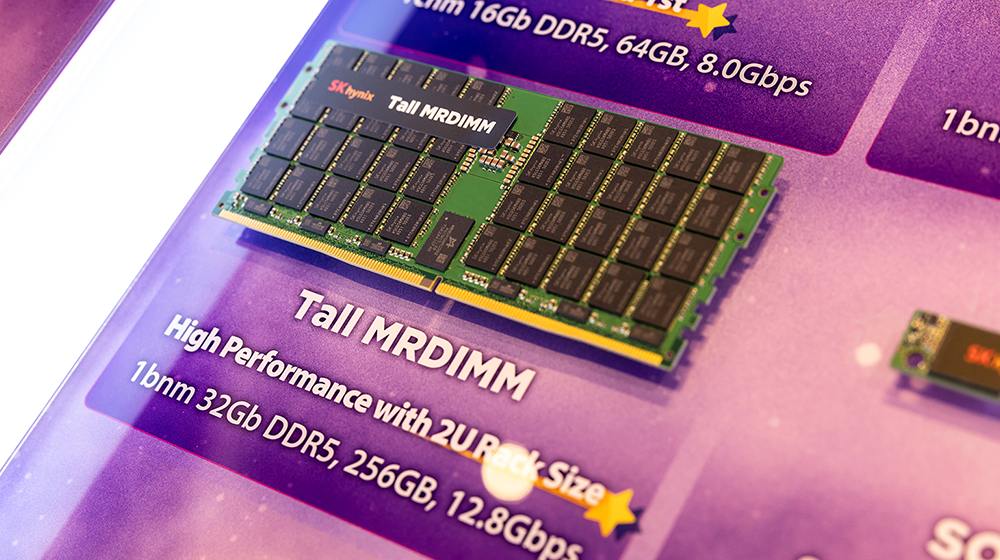
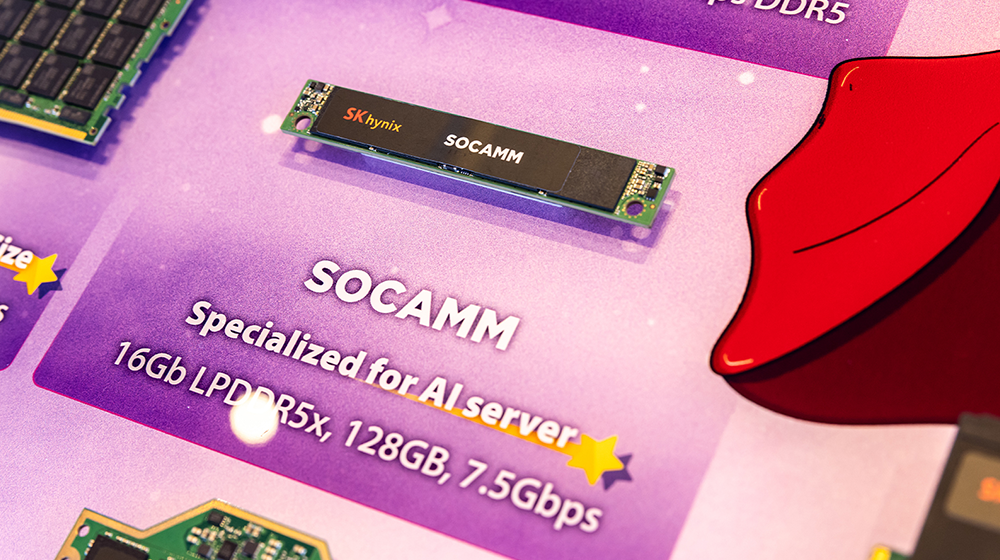
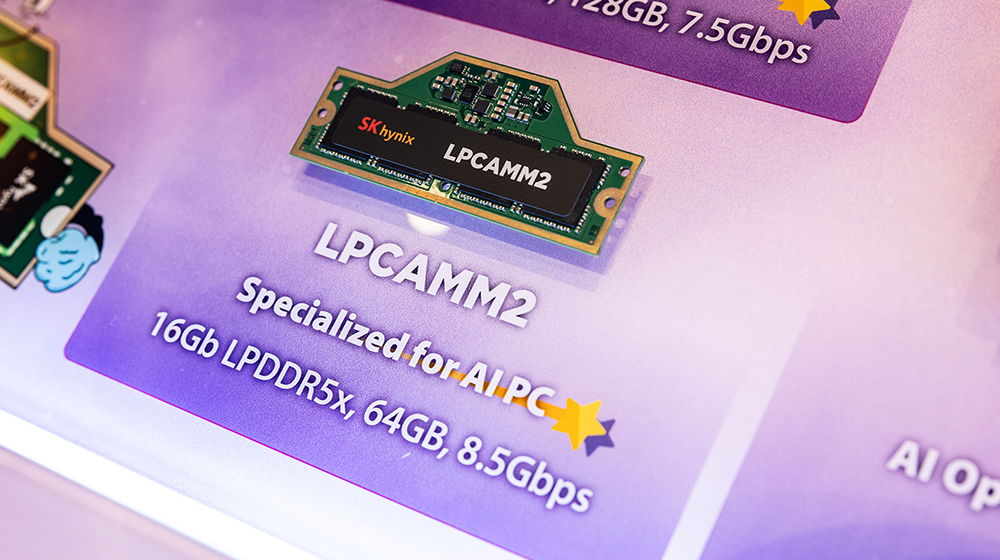
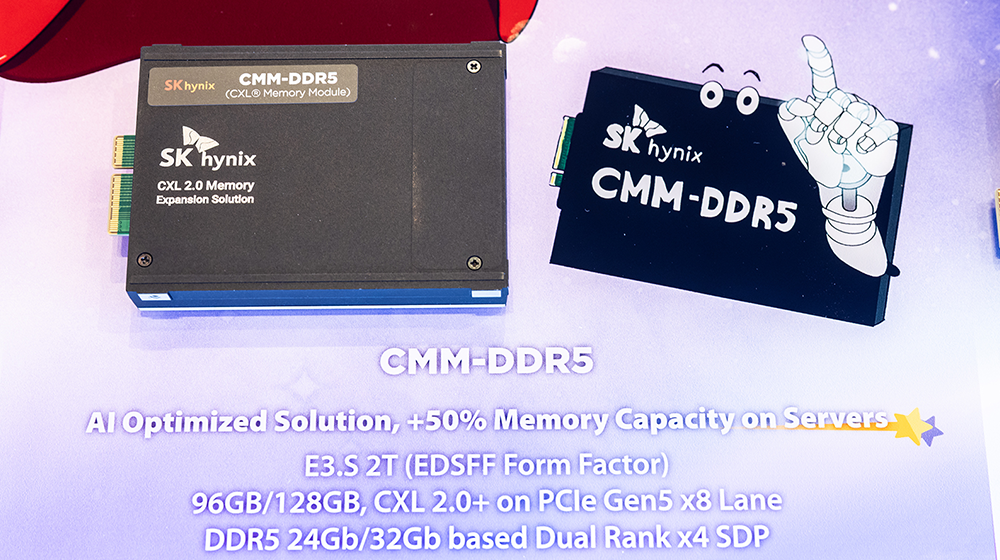
(From first image) RDIMM, 3DS RDIMM, Tall MRDIMM, SOCAMM, LPCAMM2, and CMM-DDR5 on display
SK hynix presented a wide range of next-generation products for leading the global AI memory market, including RDIMM4, 3DS5 RDIMM, Tall MRDIMM6, SOCAMM, LPCAMM2, and CXL7 Memory Module-DDR5 (CMM-DDR5). Among these, CMM-DDR5 combines DDR5 DRAM with a CXL memory controller. When applied to server systems, it offers 50% greater capacity and 30% higher bandwidth compared to conventional DDR5 modules, enabling data processing speeds of up to 36 GB per second.
4Registered Dual In-line Memory Module (RDIMM): A server memory module product in which multiple DRAM chips are mounted on a substrate.
53D Stacked Memory (3DS): A high-bandwidth memory product in which two or more DRAM chips are packaged together and interconnected using TSV technology.
6Multiplexed Rank Dual In-line Memory Module (MRDIMM): A server memory module product in which multiple DRAM chips are mounted on a substrate. Speed is enhanced by operating two ranks — the basic operating units of the module — simultaneously.
7Compute Express Link (CXL): A next-generation, open industry-standard interconnect designed to seamlessly link CPUs, GPUs, memory, and other components within high-performance computing systems. It enables large-scale, ultra-high-speed operations. Applying CXL technology to traditional memory modules can expand their capacity by up to 10 times.
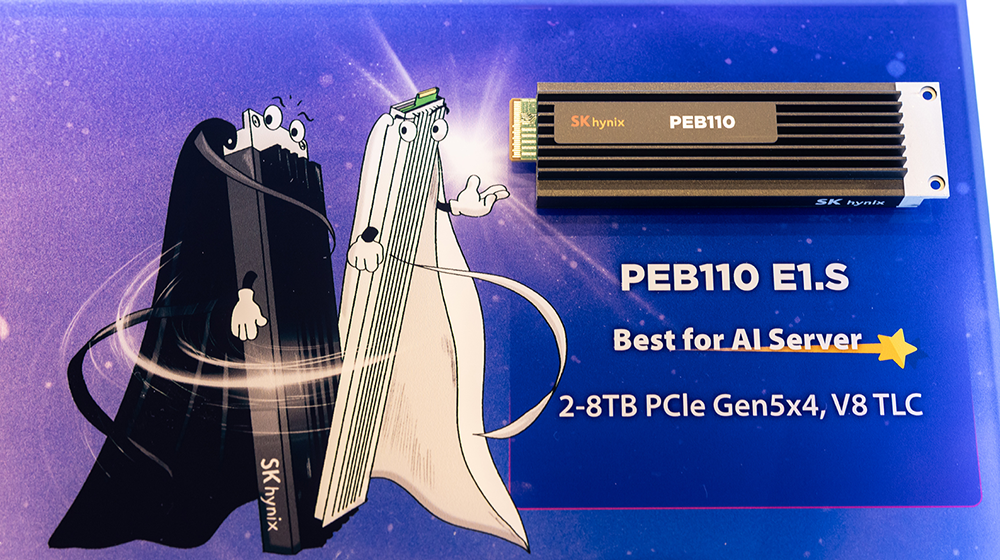
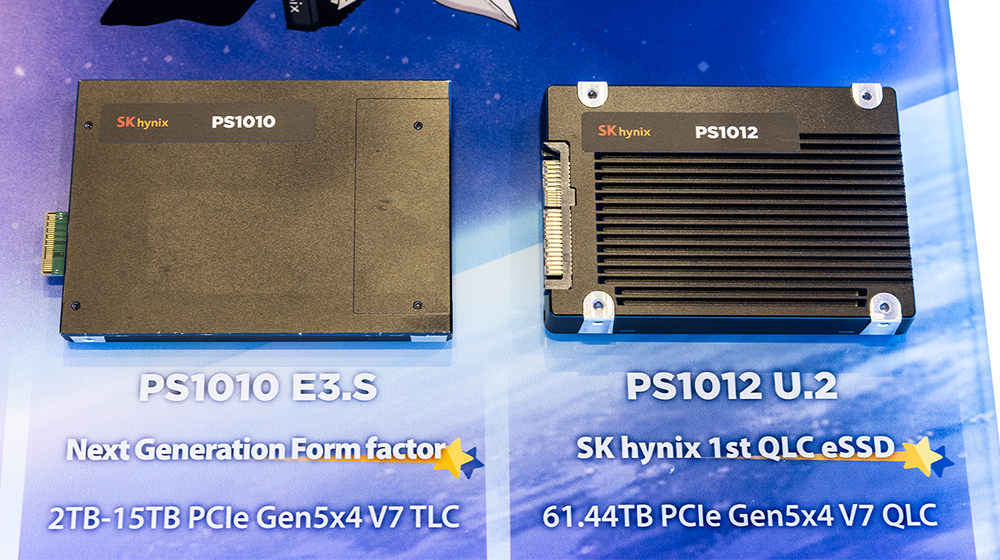
SK hynix’s high-performance eSSDs on display, including PEB110 E1.S, PS1010 E3.S, and PS1012 U.2
In addition, SK hynix showcased three high-performance eSSDs8: the PS1010 E3.S, a data center eSSD based on 176-layer 4D NAND; the PEB110 E1.S built on 238-layer 4D NAND; and the PS1012 U.29, a 61 TB product based on QLC10 technology.
8Enterprise solid-state drive (eSSD): An enterprise-grade SSD used in servers and data centers.
9U.2: A type of SSD form factor primarily used in servers and high-performance workstations. It offers large storage capacity and high durability. In particular, as it is 2.5 inches in size, U.2 provides excellent compatibility with existing server and storage systems, allowing for easy upgrades to high-performance SSDs without infrastructure changes.
10Quad-level cell (QLC): NAND flash is categorized as single-level cell (SLC), multi-level cell (MLC), triple-level cell (TLC), QLC, and penta-level cell (PLC) depending on how many data bits can be stored in one cell. As the amount of information storage increases, more data can be stored in the same volume.
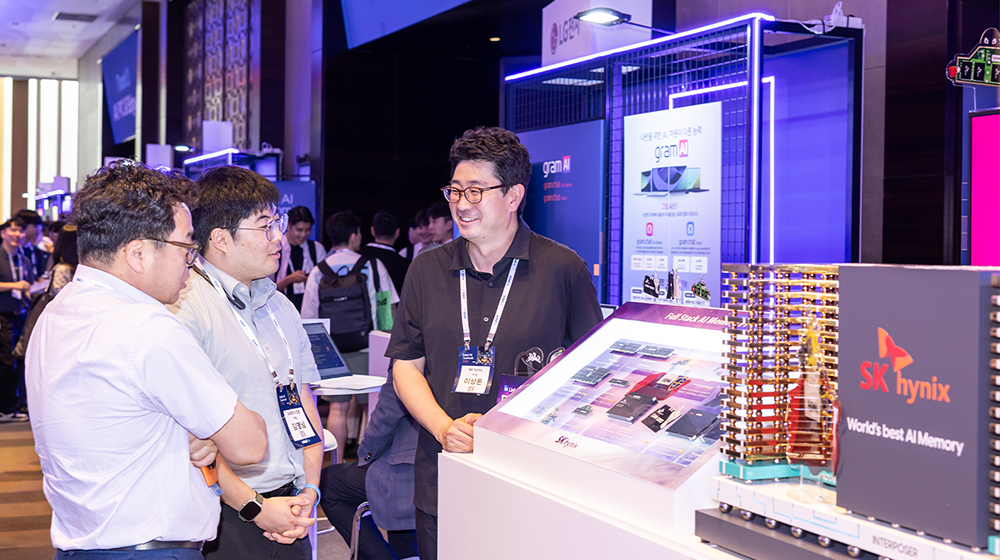
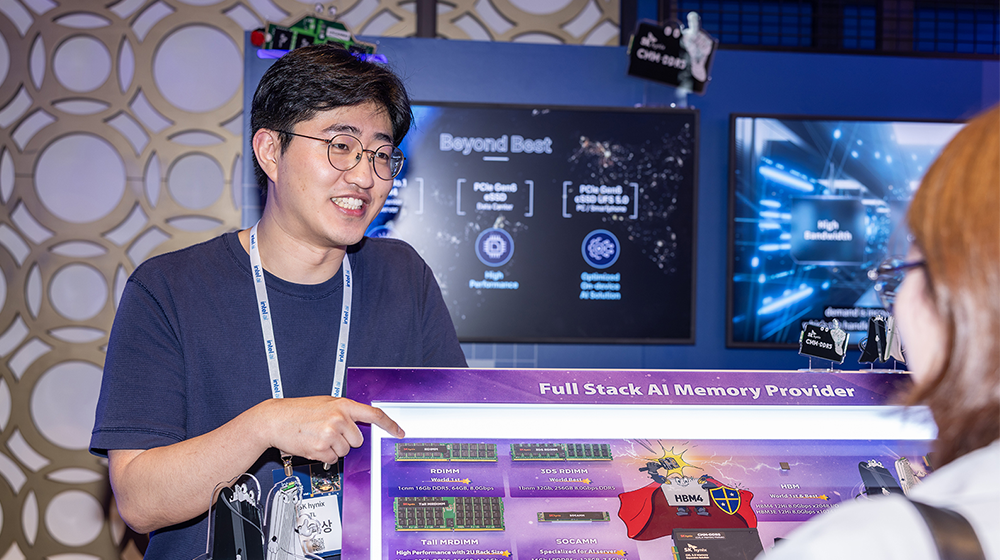
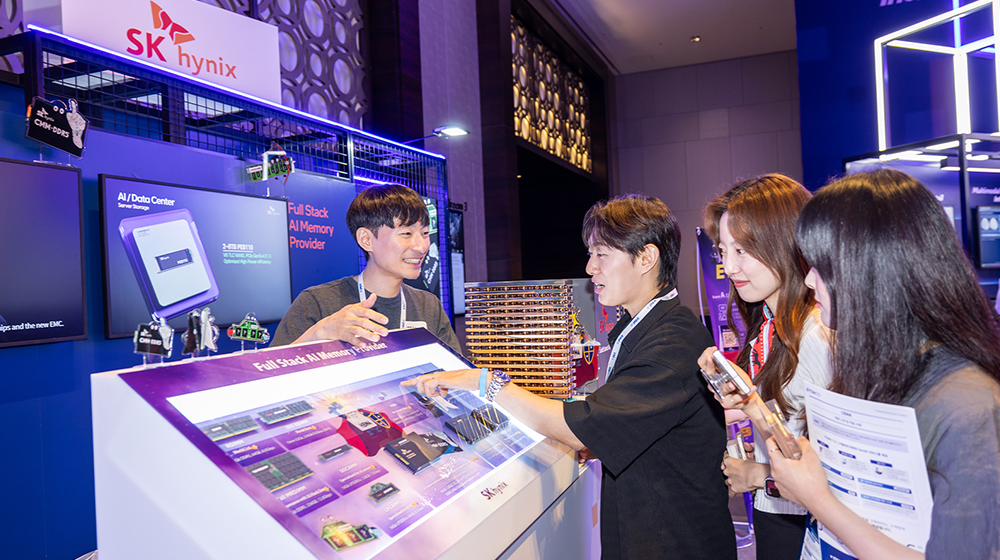
SK hynix employees introduce the company’s products and technological capabilities to visitors
Sharing Tech Knowledge and SK hynix’s Vision
In addition to presenting its technologies, SK hynix also hosted expert-led discussion sessions to strengthen communication with visitors. Product managers for RDIMM, CXL memory, and eSSDs all participated, providing in-depth explanations and answering questions. These sessions further strengthened SK hynix’s status as a global tech leader.
The event featured keynote speeches from representatives of SK hynix, Intel, Naver Cloud, and Lenovo. It also brought together experts in various fields like tech leaders, AI developers, startup employees, and government officials for in-depth discussions on AI technology trends and cross-industry collaboration opportunities.
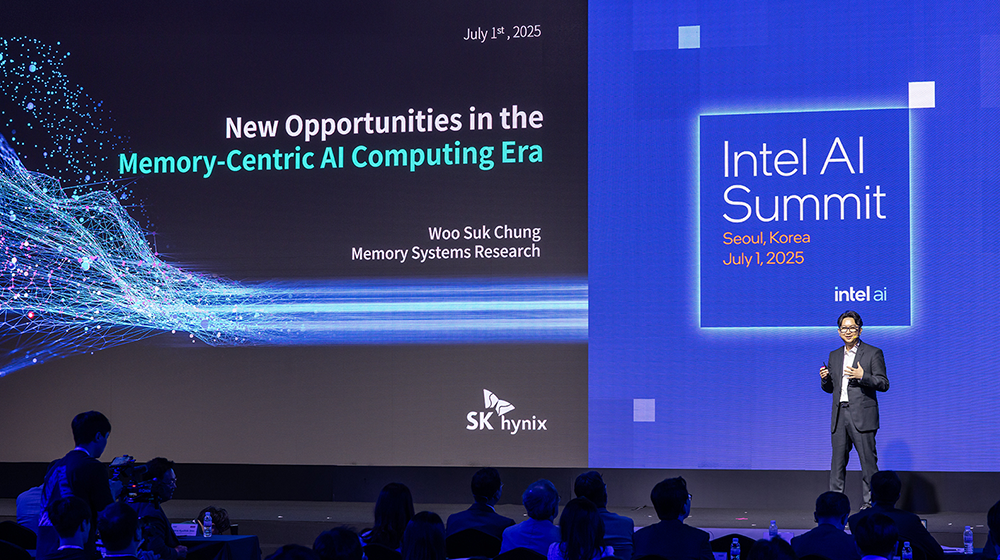
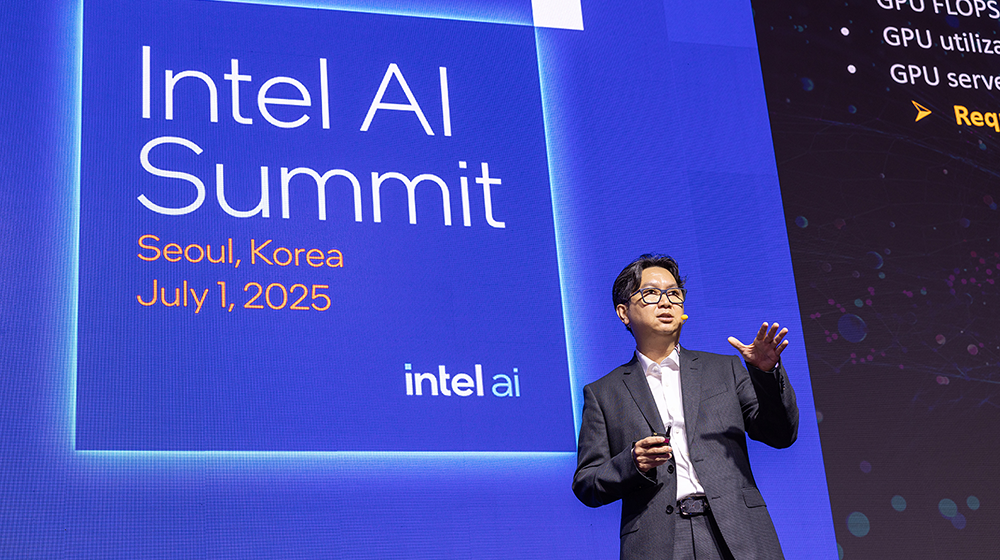
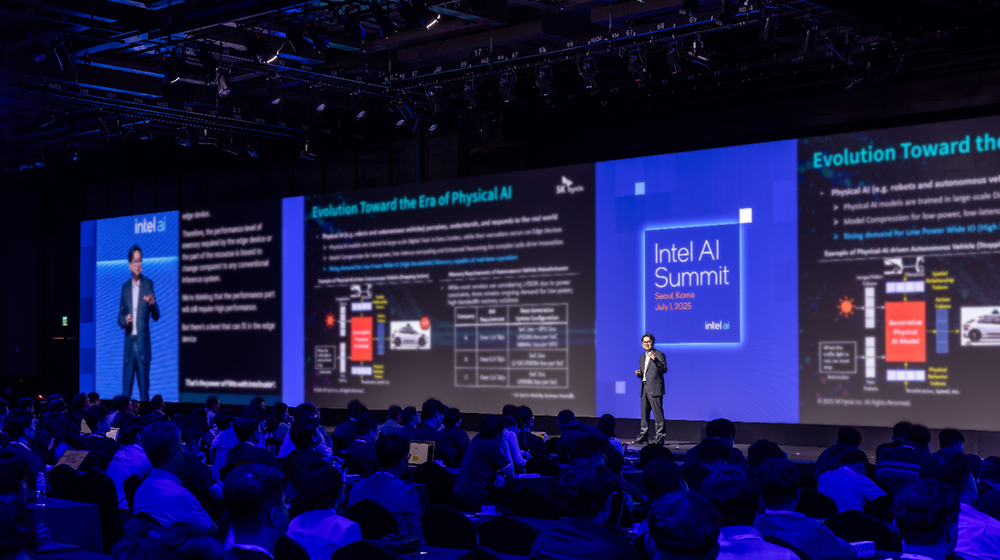
SK hynix Vice President Woosuk Chung delivers a keynote speech
In his keynote speech, SK hynix Vice President Woosuk Chung, head of Software Solution, emphasized the importance of semiconductor memory in the AI era and shared the company’s vision. Chung delivered a presentation on “New Opportunities in the Memory-Centric AI Computing Era,” highlighting the critical role of memory-centric AI computing in efficiently processing the rapidly growing volumes of data in the AI era. He also introduced SK hynix’s wide range of next-generation AI memory technologies to support this new type of computing.
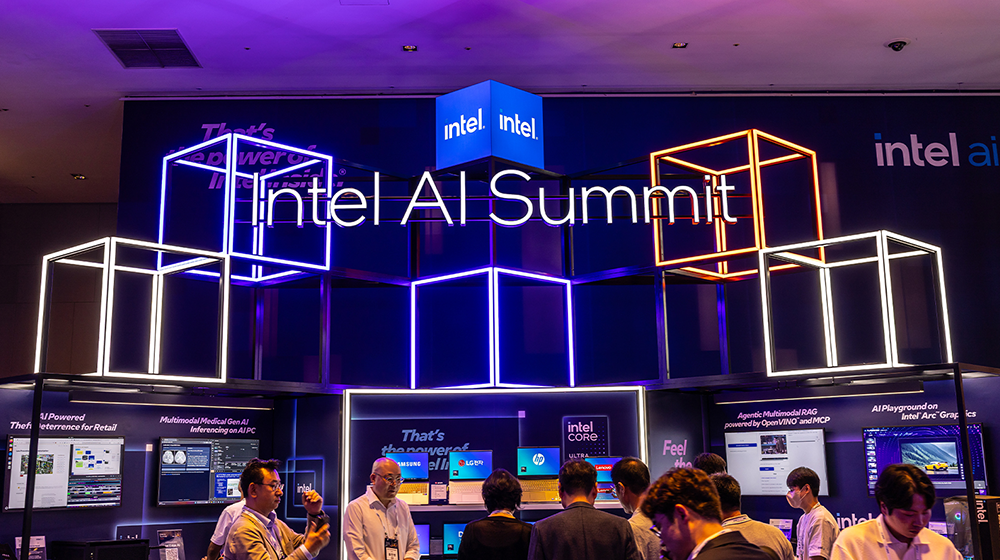
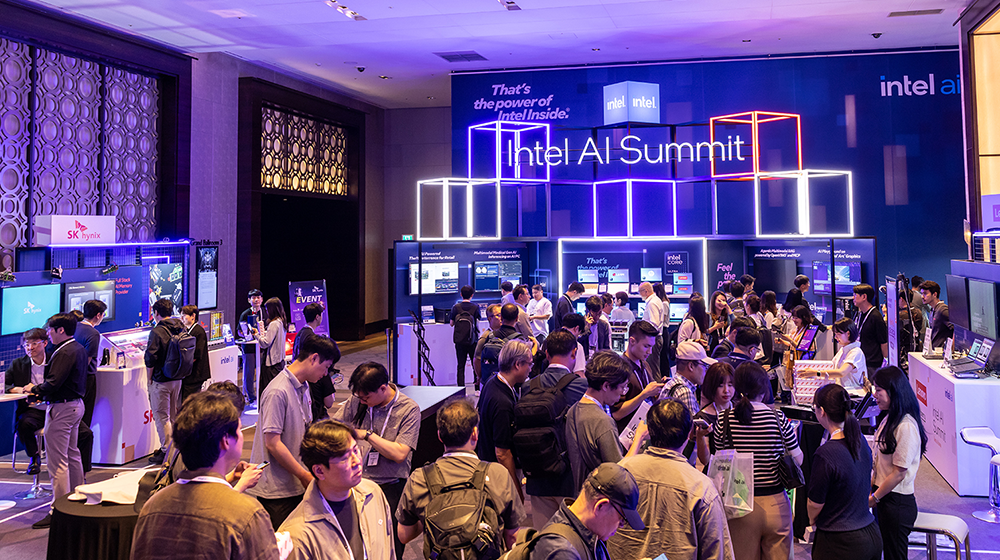
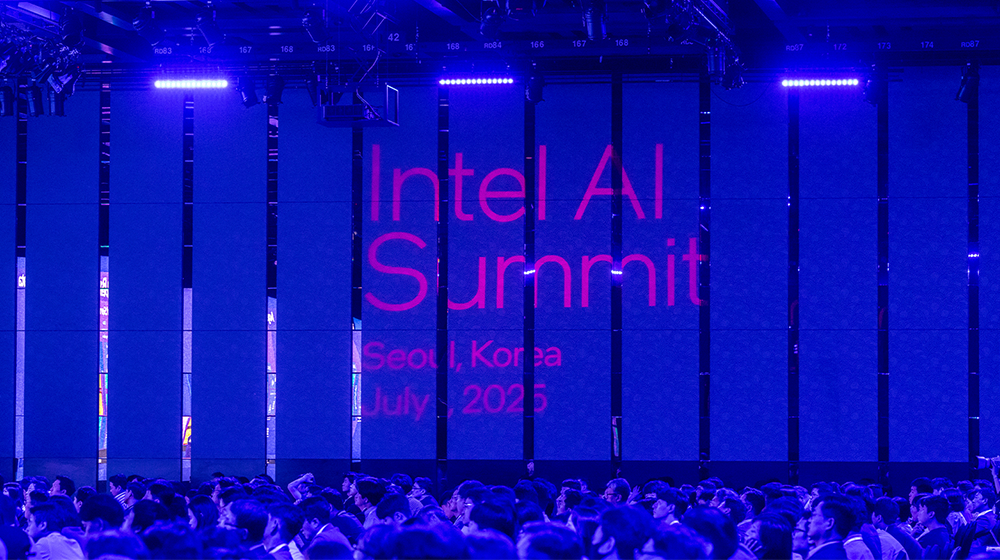
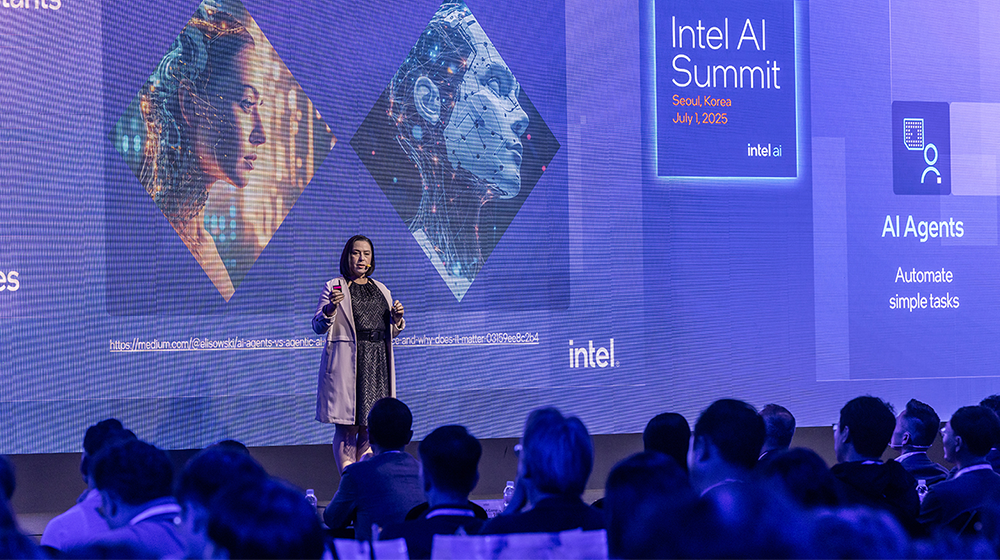
Scenes from the Intel AI Summit Seoul 2025
For SK hynix, the Intel AI Summit Seoul 2025 was a meaningful opportunity to share the present and future of its AI memory technologies that will lead the AI era. The company will continue to take the lead in accelerating the evolution of the AI ecosystem through its “one-team” partnership with Intel.