The AI boom has reshaped the priorities of the semiconductor industry. Just a few years ago, competition centered on compute hardware such as GPUs, but larger AI models and new applications have turned data storage, access and transfer into a critical factor in AI infrastructure.
Amid this shift, SK hynix has established itself as a key player and technology pioneer in the AI supply chain. Beyond its leadership in the HBM market, the company supports the broader AI infrastructure ecosystem through a comprehensive portfolio that includes DRAM, NAND flash, SSDs and low-power memory solutions.
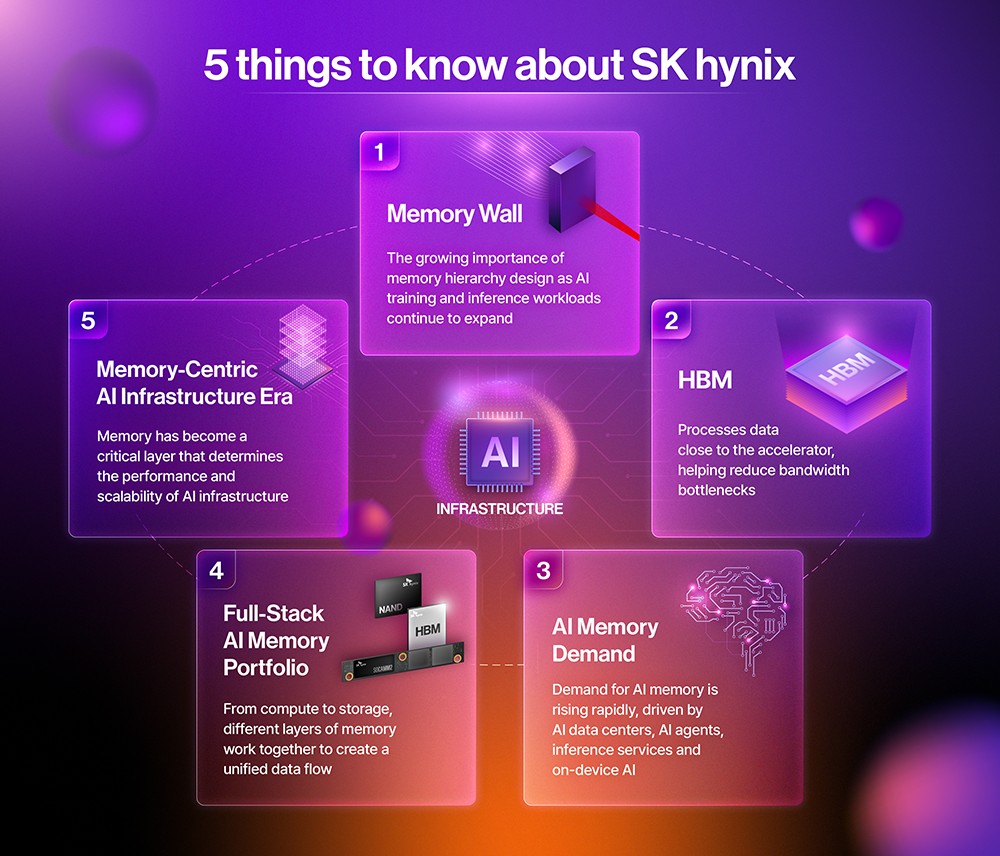
Here are five key points that illustrate the changes SK hynix is driving in AI memory and why they matter.
1. Overcoming the memory wall: A critical challenge for AI progress
AI systems handle enormous volumes of data throughout every stage of operation, including training, inference, real-time services and long-context processing. As models become larger and usage scenarios grow more complex, AI accelerators require a continuous flow of data to operate at their full potential.
If the necessary data cannot be delivered on time, even the most powerful processors cannot be fully utilized. This gap between processor computing speed and memory data delivery speed — known as the memory wall — has emerged as a major challenge across AI infrastructure. In AI systems, this gap can become a bottleneck that limits performance, efficiency and scalability.
Ultimately, competitiveness in the AI era depends not only on how fast a chip can compute, but also on how quickly and reliably data can move throughout the system. For this reason, AI performance is no longer determined solely by compute capability. Memory bandwidth, capacity, power efficiency, latency and reliability all play critical roles in overall system performance.
Memory is no longer a supporting component for computation. It has become a core infrastructure element that determines how efficiently AI systems can operate and scale in real-world service environments.
2. HBM: The core technology behind AI acceleration
High-bandwidth memory (HBM) is designed to address the memory wall by supplying massive amounts of data to AI accelerators at high speed, helping to ensure that computing resources can perform at their full potential.
HBM achieves high bandwidth within a compact footprint by vertically stacking multiple DRAM dies. By enabling high-throughput data transfer between memory and high-performance processors, it reduces bottlenecks and improves overall system efficiency. These characteristics are particularly important in environments that must process enormous amounts of data, such as large-scale AI training and high-performance inference.
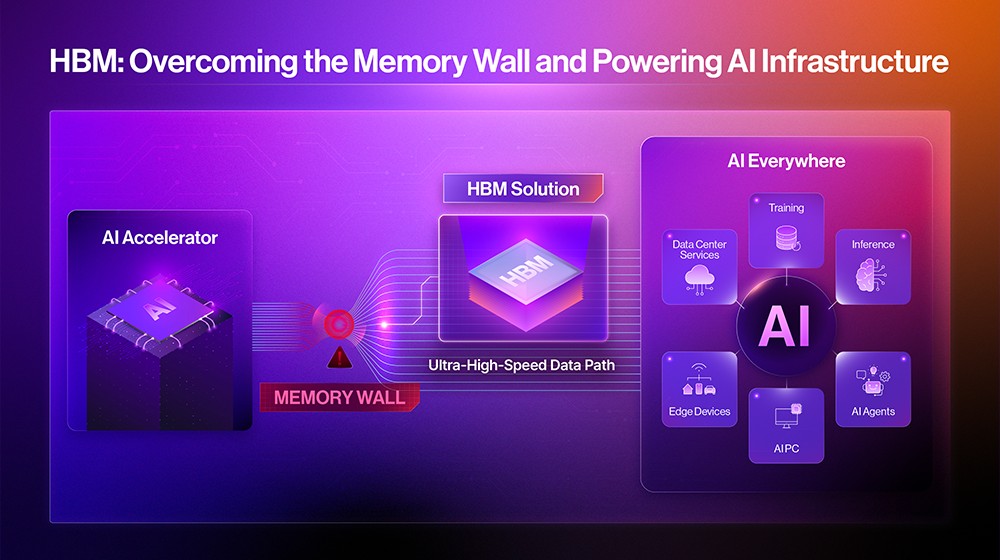
HBM has become one of the clearest examples of SK hynix’s role in the AI ecosystem, directly linking the company to advanced AI accelerators, high-performance data centers and large-scale AI workloads. As models and workloads grow larger and more complex, next-generation solutions like the company’s HBM4 are expected to become even more important. HBM has become a foundational memory technology driving modern AI computing.
3. AI memory demand expands beyond training to inference and industrywide adoption
Early discussions around AI infrastructure focused primarily on training, since training large-scale models requires enormous computing performance, high memory bandwidth and sufficient memory capacity.
Today, however, the AI market is rapidly expanding beyond training into inference and real-world deployment. AI adoption is accelerating across search, enterprise tools, content generation, personal agents, AI PCs, edge devices and data center services, as well as industries such as manufacturing, finance, healthcare and mobility. As this transition unfolds, the importance of inference continues to grow. Inference is the stage at which trained models respond to real user requests, and it occurs continuously and repeatedly in large-scale service environments.

This trend is also reflected in memory demand forecasts because as AI infrastructure and on-device AI continue to expand, demand is expected to grow not only for HBM but also for server and system memory, as well as high-capacity storage. This underscores how AI memory is no longer confined to a single product category and is instead expanding across the broader portfolio, from HBM and AI-DRAM to AI-NAND.
These changes are also diversifying the requirements placed on memory. For training workloads, high bandwidth and large capacity are critical. For inference, however, fast responsiveness, efficient data processing and the ability to handle long-context workloads become increasingly important. As AI expands into industrial environments, everyday devices and data center services, memory must be capable of retrieving, storing and reusing the data required to run AI models more quickly and efficiently.
AI is progressing from model development to large-scale deployment, so memory requirements are broadening beyond accelerator-focused training systems to encompass the full AI infrastructure stack.
4. SK hynix’s full-stack AI memory portfolio
As AI workloads become more diverse, no single memory technology can satisfy every requirement. The core concept behind SK hynix’s full-stack AI memory strategy is that HBM, AI-DRAM and AI-NAND each address different challenges within AI infrastructure.
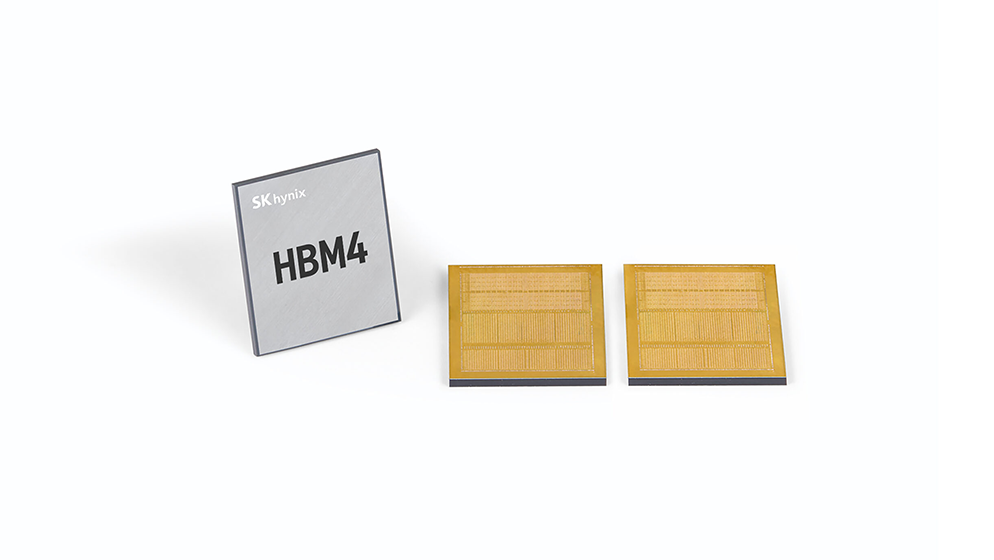
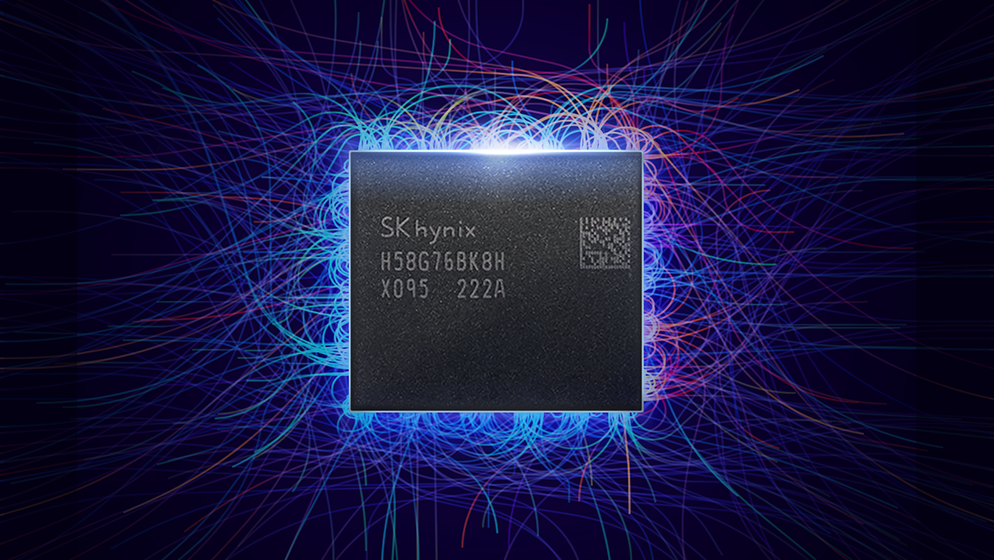
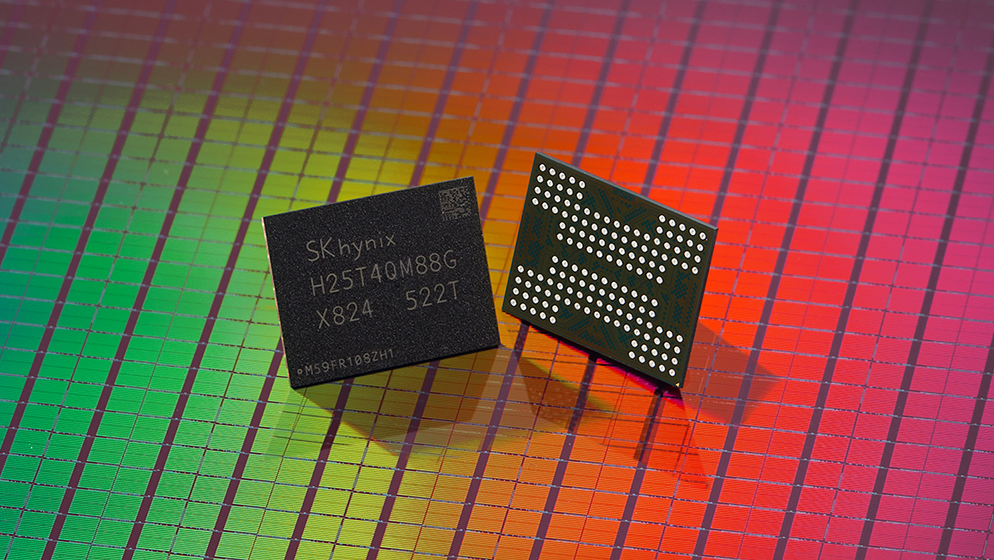
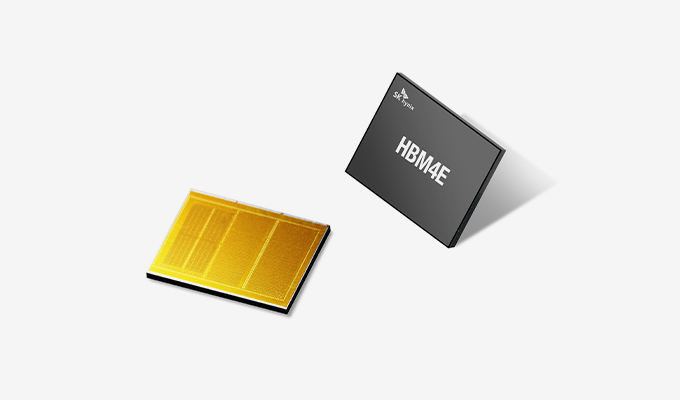
HBM works closely with AI chips such as GPUs and ASICs, supplying the ultra-high-bandwidth data required by AI accelerators. Through next-generation HBM products including HBM4 and HBM4E, SK hynix is addressing growing demand for high-performance AI infrastructure.
AI-DRAM extends the company’s HBM technology leadership into the server and system memory domains. Through cutting-edge products such as SOCAMM2, GDDR7 and DDR5, SK hynix contributes to improving the performance and efficiency of servers and computing platforms in the AI era.
AI-NAND addresses growing storage demand driven by the expansion of the AI inference market. The company’s 245TB QLC eSSD and next-generation high-performance storage technologies play an important role in AI data center environments, where massive volumes of data must be stored reliably and retrieved quickly.
SK hynix’s full-stack AI memory strategy is more than a broad portfolio of products. HBM delivers the bandwidth needed close to compute resources, AI-DRAM supports system performance and AI-NAND enables data storage and utilization. Together, these three layers enable AI infrastructure to scale much more efficiently.
5. The era of memory-centric AI infrastructure and the role of SK hynix
AI infrastructure is becoming increasingly specialized. Data center training clusters, enterprise AI services, AI PCs and edge devices all use memory in different ways. Each environment requires a different balance of bandwidth, capacity, power efficiency, latency, reliability and storage performance.
SK hynix’s strategy reflects this shift. Building on its leadership in HBM, the company is expanding its portfolio into AI-DRAM and AI-NAND while advancing its vision of becoming a ‘full stack AI memory creator’ that supports the entire AI infrastructure ecosystem. This vision goes beyond simply competing in a single product category or generation to supporting the entire data lifecycle of AI systems from a memory perspective, encompassing data processing, storage and reuse.
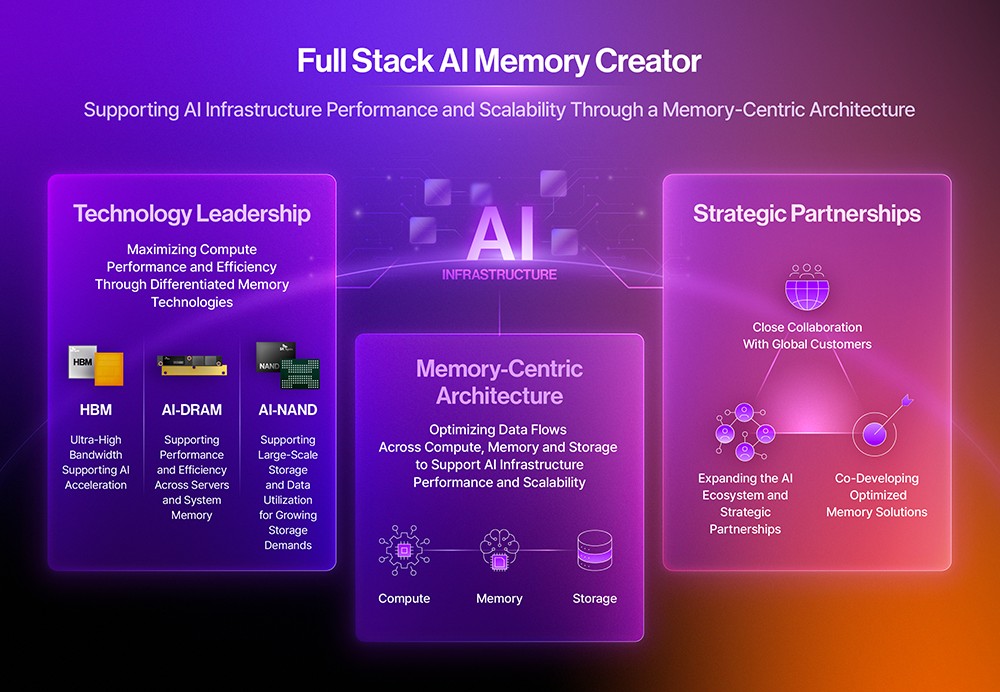
In this process, SK hynix’s role extends beyond product supply. Through strategic collaboration with global customers, AI-related research capabilities and the development of next-generation memory technologies, the company is evolving into a technology partner that proposes memory solutions optimized for specific workloads and helps lead the transition toward memory-centric AI architectures.
The next phase of AI will not be determined by computing performance alone, but also by how efficiently data can be moved, stored and reused across increasingly complex systems. By innovating across its full-stack AI memory portfolio, SK hynix is helping to build that foundation and shape the future of AI infrastructure.