
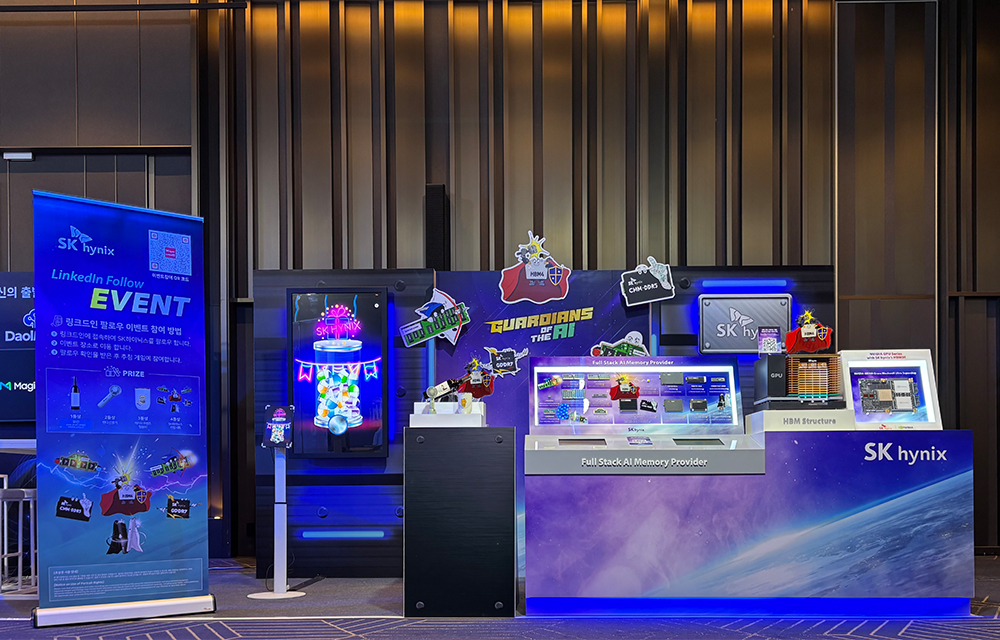
SK hynix showcased groundbreaking memory solutions tailored for the AI era at Dell Technologies Forum 2025 held on September 17 in Seoul, Korea.
Dell Technologies Forum is a series of regional tech conferences linked to the company’s annual flagship event Dell Technologies World in Las Vegas. The forum held in Seoul is one of Korea’s largest IT conferences, inviting key stakeholders. Held under the theme “Beyond the Limits of Imagination,” this year’s event attracted more than 4,000 attendees for technical sessions, product demonstrations and immersive showcases.
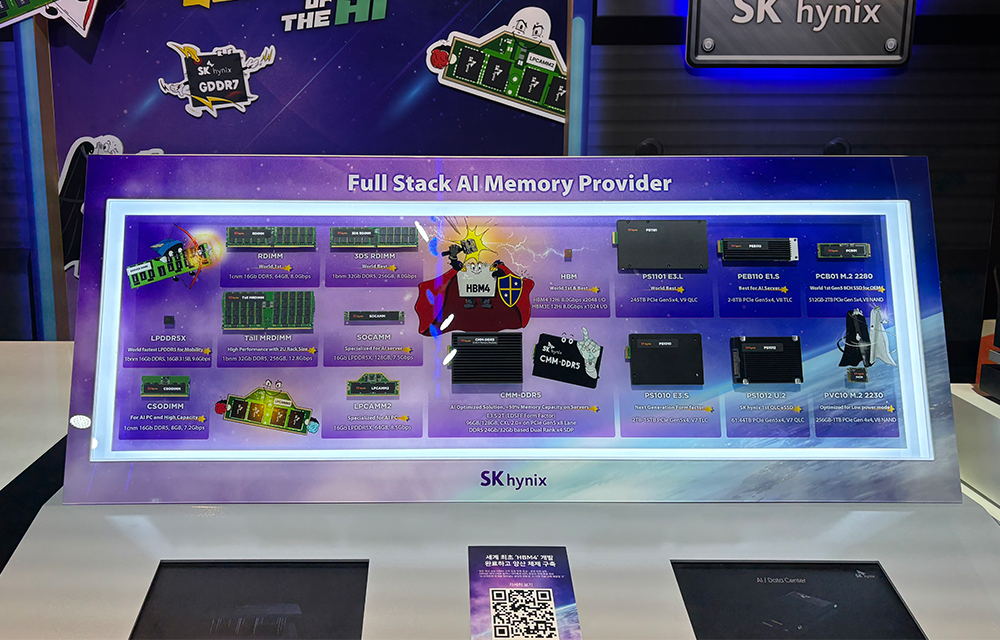
▲ Cutting-edge AI memory solutions on display at SK hynix’s booth
During the forum, SK hynix presented its product portfolio for AI infrastructure under the slogan “Guardians of the AI – Full-Stack AI Memory Provider.” The company’s booth, featuring distinctive characters, captivated visitors by highlighting its core technologies in an accessible manner.
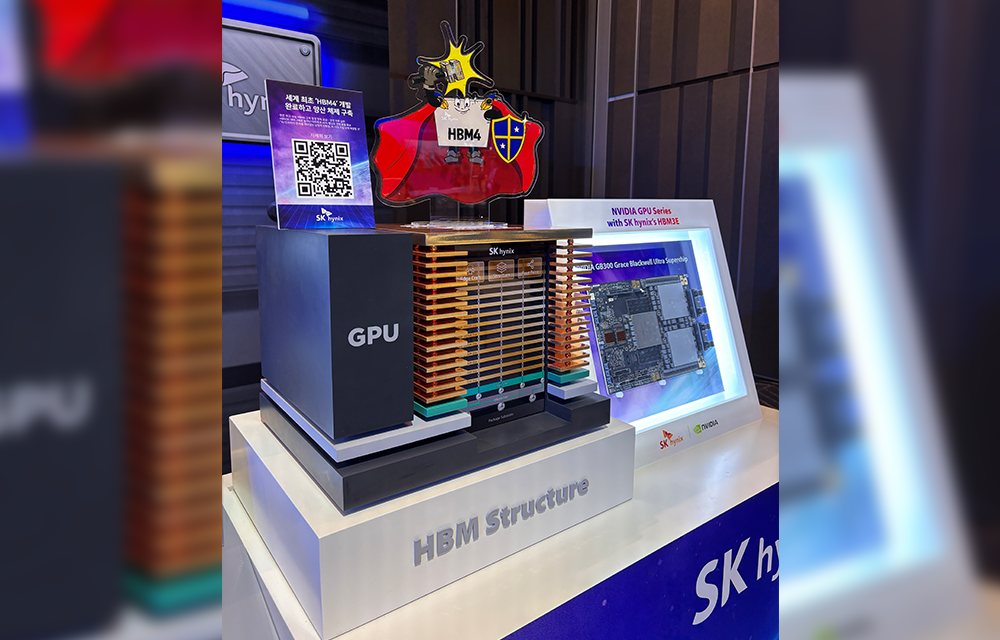
▲ A 3D model of the technologies used in the 12-layer HBM4
SK hynix’s HBM* lineup was the centerpiece of its booth. On September 12, the company announced that it had become the first in the world to complete development of HBM4 and establish the product’s mass production system. As a next-generation memory solution for AI systems, HBM4 offers the world’s fastest data processing speed of 2 terabytes (TB) per second. Visitors could see the 12-layer HBM4 as well as 3D models of the technologies used in HBM such as TSV* and Advanced MR-MUF* . The booth also featured the NVIDIA GB300 Grace Blackwell GPU, which includes the industry’s highest-performing and largest capacity HBM3E chip.
* High Bandwidth Memory (HBM): A high-value, high-performance memory product which vertically interconnects multiple DRAM chips and dramatically increases data processing speed in comparison to conventional DRAM products. There are six generations of HBM, starting with the original HBM followed by HBM2, HBM2E, HBM3, HBM3E, and HBM4.
* Through silicon-via (TSV): A technology that connects vertically stacked DRAM chips by drilling thousands of microscopic holes through the silicon and linking the layers with vertical electrodes.
* Advanced Mass Reflow-Molded Underfill (MR-MUF): A next-generation MR-MUF technology which offers enhanced warpage control, enabling stacking of chips 40% thinner than previous generations. With new protective materials, it also provides improved heat dissipation.
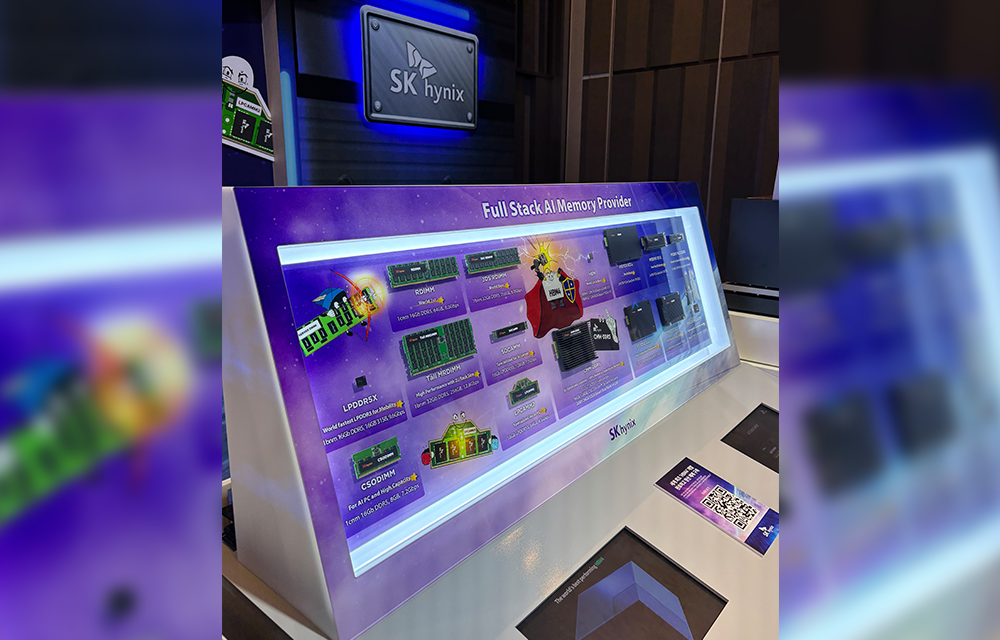
▲ SK hynix’s versatile lineup of DRAM products on display
In the DRAM section, LPDDR5X* stood out for its high speed and low-power consumption. Optimized for mobile devices such as smartphones, tablets, and laptops, LPDDR5X is gaining traction amid the continued expansion of on-device AI. The innovative LPCAMM2* , which integrates multiple LPDDR5X chips into a single compact module, also garnered attention for blending high performance with low-power consumption.
* Low Power Double Data Rate 5X (LPDDR5X): A next-generation, low-power mobile DRAM product. The “LP” prefix stands for low power. The LPDDR standard has been developed in the order of LPDDR1, 2, 3, 4, 4X, 5, and 5X, with LPDDR5X representing the seventh-generation LPDDR product.
* Low Power Compression Attached Memory Module 2 (LPCAMM2): An LPDDR5X-based module solution that offers power efficiency and high performance as well as space savings. It delivers performance levels equivalent to two DDR5 SODIMMs.
The DRAM section also featured various updated DRAM module products. These included RDIMM* and CSODIMM* which leverage the 1c* node — the sixth generation of 10 nm process technology —as well as 3DS* RDIMM, Tall MRDIMM* , and SOCAMM* . The lineup underscored the versatility of SK hynix’s technologies in powering a wide range of devices, from PCs to AI servers.
* Registered Dual In-line Memory Module (RDIMM): A server memory module product in which multiple DRAM chips are mounted on a substrate.
* Compression SODIMM (CSODIMM): A next-generation memory module with a thinner and more compact form factor than traditional SODIMMs, designed to deliver high capacity for AI PCs and high-performance laptops.
* 1c: The 10 nm DRAM process technology has progressed through six generations: 1x, 1y, 1z, 1a, 1b, and 1c. In August 2024, SK hynix became the first in the world to successfully develop 1c process technology.
* 3D Stacked Memory (3DS): A high-performance memory solution in which two or more DRAM chips are packaged together and interconnected using TSV technology.
* Multiplexed Rank Dual In-line Memory Module (MRDIMM): A server memory module product with enhanced speed by simultaneously operating two ranks — the basic operating units of the module.
* Small Outline Compression Attached Memory Module (SOCAMM): A low-power DRAM-based memory module specialized for AI servers.
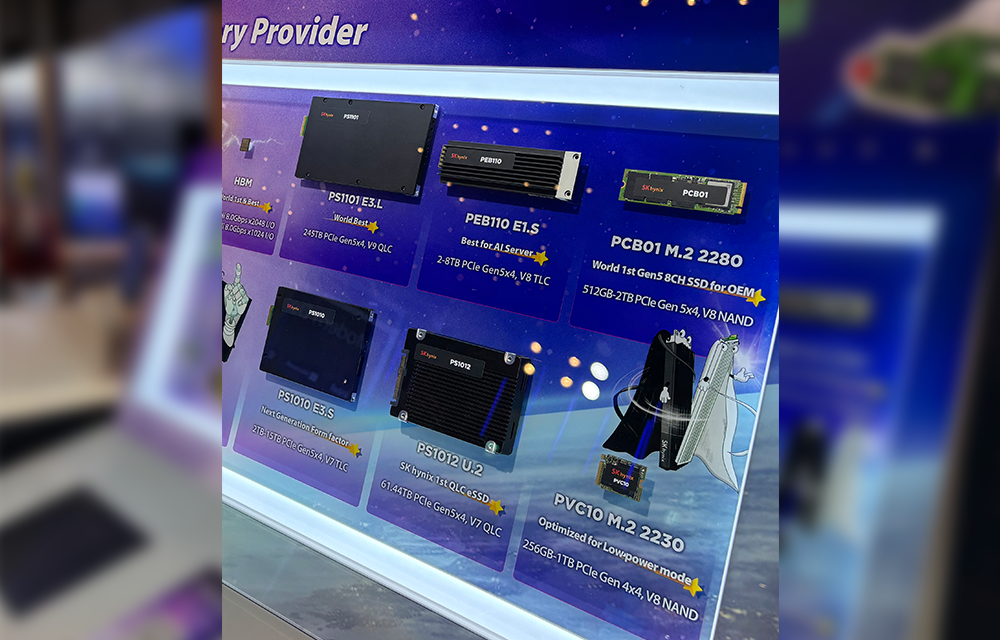
▲ SK hynix’s groundbreaking eSSDs and cSSDs offer exceptional performance and capacity
The storage section featured various advanced eSSD* and cSSD* products. SK hynix presented eSSDs optimized for AI servers and data centers, including PEB110, PS1010, PS1012, and PS1101. In particular, PS1012, a 61 TB Gen5 PCIe* product based on QLC* technology, garnered significant attention. Offering double the bandwidth of Gen4 PCIe-based products, PS1012 is ideal for AI infrastructure requiring both high performance and large capacity. Another highlight was the groundbreaking PS1101 which offers an industry-leading capacity of 245 TB, addressing rapidly growing storage demands. SK hynix also presented its high-performance PCB01 cSSD, which provides rapid sequential read speeds of 14 gigabytes per second (GB/s) and sequential write speeds of 12 GB/s, making it optimized for on-device AI.
* Enterprise solid-state drive (eSSD): An enterprise-grade SSD used in servers and data centers.
* Client solid-state drive (cSSD): SSDs intended for consumer use, commonly found in personal electronic devices such as PCs and tablets.
* Peripheral Component Interconnect Express (PCIe): A high-speed input/output interface with a serial structure used on the main board of a digital device.
* Quad-level cell (QLC): A type of memory cell used in NAND flash that stores four bits of data in a single cell. NAND flash is categorized as single-level cell (SLC), multi-level cell (MLC), triple-level cell (TLC), QLC, and penta-level cell (PLC) depending on how many data bits can be stored in one cell. As the amount of information storage increases, more data can be stored in the same volume.
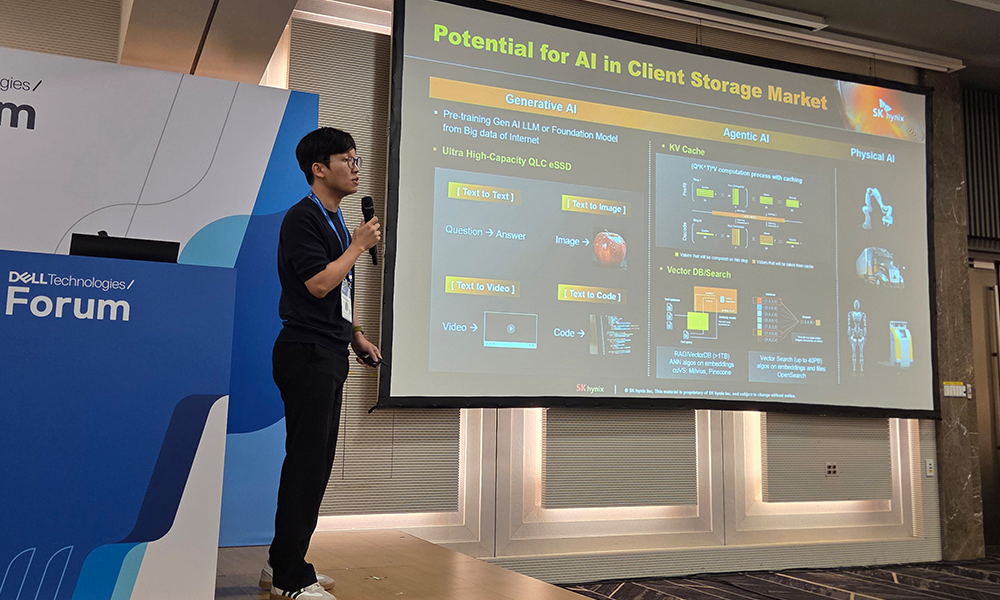
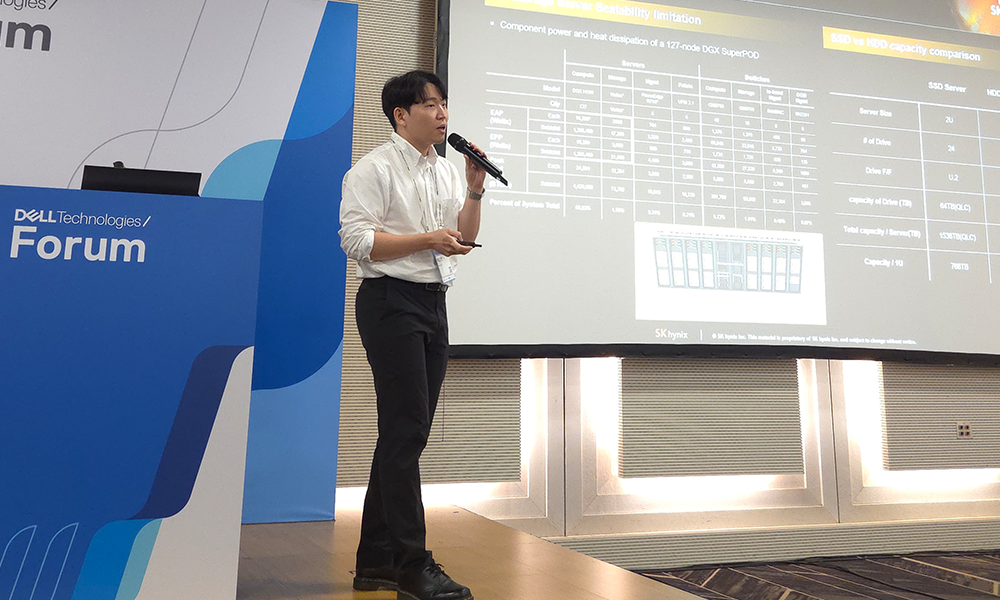
SK hynix also shared its technological expertise during sessions at the forum. Technical Leaders Jungwon Park and Gyoyoung Lee of SSD Product Planning delivered a presentation titled “Key Things for AI Storage”. They introduced the company’s lineup of cSSDs and eSSDs, which are essential components for optimizing AI performance, as well as the products’ core features. In particular, the speakers’ business insights on AI storage technologies and market forecasts resonated with the audience.
At Dell Technologies Forum 2025, SK hynix continued its journey to becoming a full-stack AI memory provider and strengthened its partnership with the host. The company will continue to innovate and lead the industry with cutting-edge memory solutions for various applications including AI servers, data centers, and on-device AI.
Related content
-
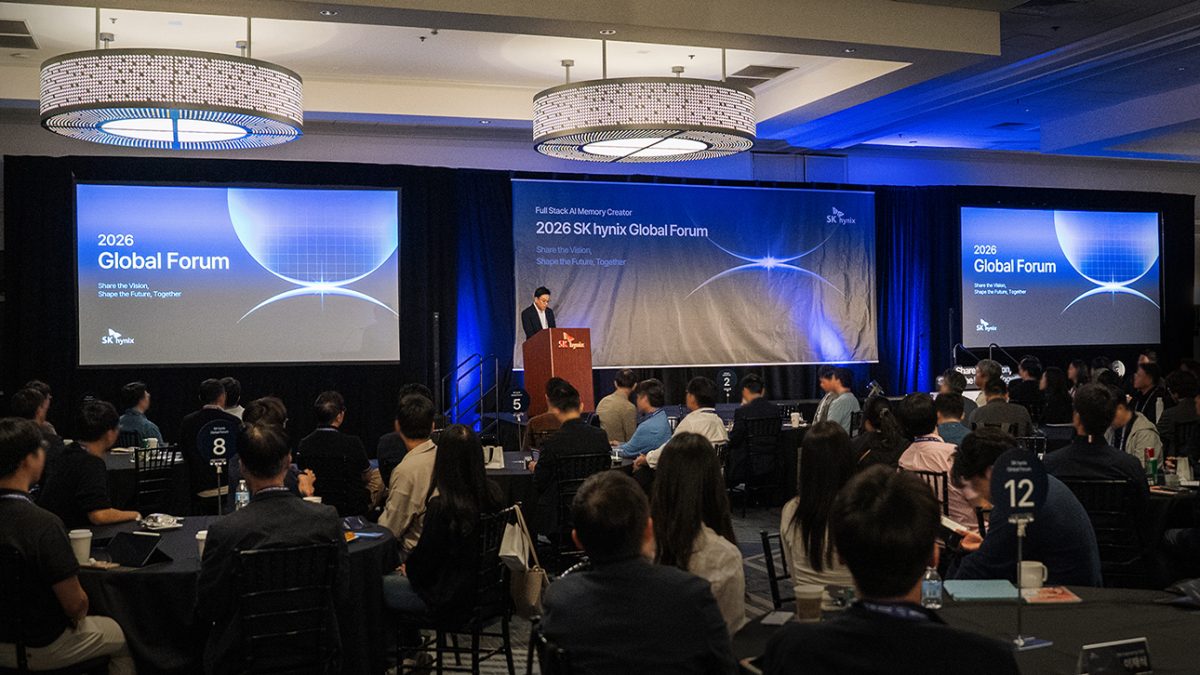 SK hynix Hosts ‘2026 Global Forum,’ Sharing Its Technology Vision and Future Strategy for the AI EraSeptember 21, 2026
 -
 SK hynix Presents ‘New Spectrum’ for AI Infrastructure at ‘AI Infra Summit 2026’September 17, 2026
 -
 SK hynix Charts Its Business and Technology Direction at the 2026 Future Forum—”Now Is the Golden Time to Leap Forward”September 9, 2026
 -
 [AI Ecosystem] The real bottleneck: Data, not computeSeptember 3, 2026