[Summary]
To proactively address the rapidly growing global demand for AI memory, SK hynix has established a mid-to-long-term investment strategy totaling KRW 1,100 trillion, encompassing Yongin, Cheongju, and the Southwestern Region.
Originally scheduled for completion in 2045, the Yongin Semiconductor Cluster now aims to complete its fourth fab by 2033, bringing its construction schedule forward by 12 years. With phased investments in manufacturing facilities and production equipment, total investment in the Yongin Cluster is expected to reach KRW 600 trillion.
In addition, SK hynix will expand its production base in Cheongju(through an investment of KRW 100 trillion), while investing KRW 400 trillion in the Southwestern Region to develop a new semiconductor cluster, as the region is expected to provide the large-scale site and supporting infrastructure—including reliable electricity and water supply—required for the company’s next manufacturing hub.
This strategic decision reflects the company’s proactive response to rapidly increasing global AI memory demand. SK hynix will build new fabrication facilities sequentially while executing investments flexibly in accordance with market conditions and its investment principles.
These investments will serve as a foundation for South Korea’s emergence as a global AI powerhouse while becoming a driving engine for the global AI ecosystem.
AI Advancement Driving Up Memory Demand
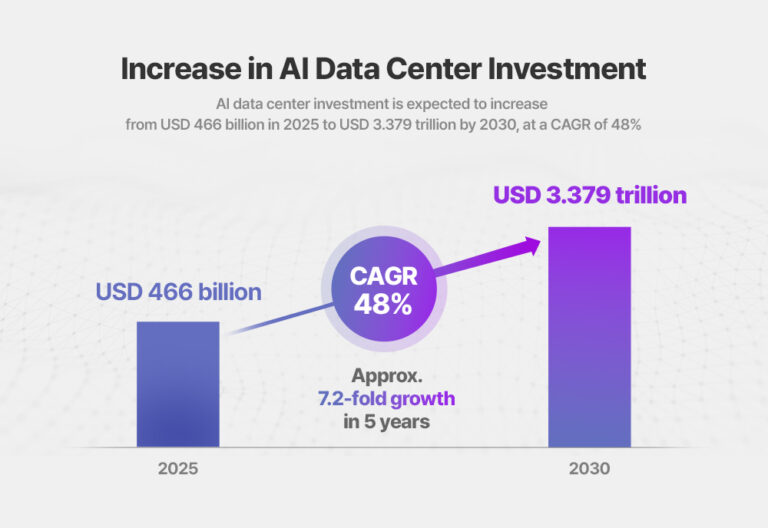
With the arrival of the AI era, demand for advanced memory solutions is expanding across different sectors. As AI continues to evolve at an unprecedented pace, investments in AI data centers that power these technologies are accelerating worldwide. According to Nomura Securities, global investment in AI data centers is expected to increase from USD 466 billion in 2025 to USD 3.379 trillion by 2030, representing approximately 7.2-fold growth in just five years. This translates into a compound annual growth rate (CAGR) of approximately 48%. This surge in investment is fueling demand for AI semiconductors, which in turn is driving the growth of the memory market. AI is no longer limited to a specific product category–it has become the primary growth engine for the entire memory industry.
The memory semiconductor market is already under significant supply pressure, with demand outpacing supply. If this imbalance continues to intensify, it could result not only in excessive price increases but also, over the long term, in market contraction and constraints on the growth of the AI industry. Ensuring a stable and sustainable market will require a substantial expansion of memory semiconductor supply.
SK hynix has consistently responded to this demand through technological innovation and proactive capacity expansion. However, since building semiconductor fabrication facilities requires many years, preparation for new production sites has become increasingly important.
SK hynix Earmarks KRW 1,100 Trillion for Mid-to-Long-Term Investments
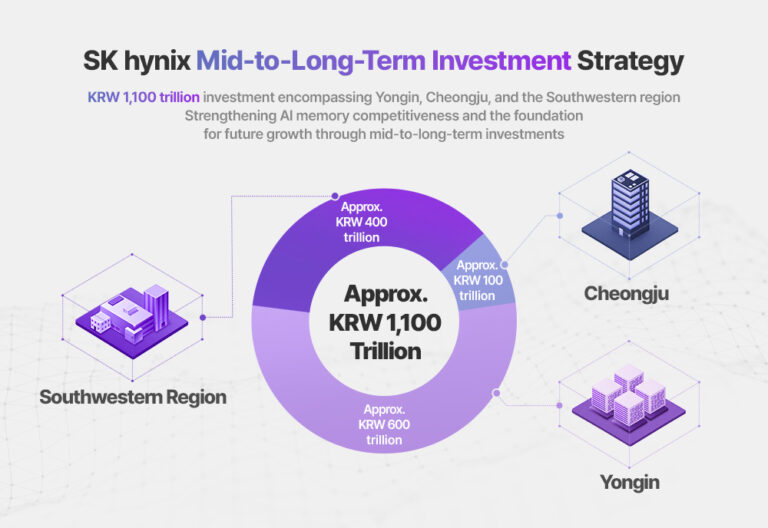
To respond to these market changes, SK hynix has established a KRW 1,100 trillion mid-to-long-term investment strategy encompassing Yongin, Cheongju, and the Southwestern Region. The company plans to invest KRW 600 trillion in Yongin, KRW 100 trillion in Cheongju, and KRW 400 trillion in the Southwestern Region in phases.
Construction of the Yongin Semiconductor Cluster is being accelerated in line with growing market demand, while Cheongju continues to expand as a key production base for AI memory. In addition, the company is preparing the Southwestern Cluster as its next major manufacturing hub.
In the AI era, manufacturing competitiveness ultimately depends on how much production capacity can be secured.
As semiconductor process technologies continue to advance, more manufacturing space is required to produce the same output. Furthermore, HBM requires more wafers than conventional DRAM to produce the same memory capacity, resulting in significantly higher production resource requirements. Securing sufficient production capacity in advance has therefore become one of the most critical competitive advantages.
SK hynix has consistently made investment decisions based on two key principles: business competitiveness and operational efficiency. This mid-to-long-term investment strategy follows the same principles by anticipating rapidly changing market demand and proactively preparing the necessary manufacturing infrastructure.
Accelerating the Yongin Semiconductor Cluster to Meet Market Demand
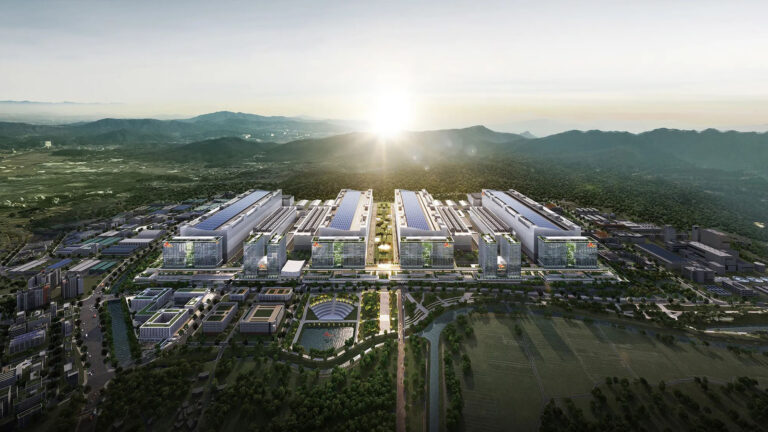
▲ Yongin Semiconductor Cluster (Artist’s rendering)
SK hynix has been fine-tuning the construction schedule of the Yongin Semiconductor Cluster to meet rapidly growing DRAM demand.
To meet rapidly growing DRAM demand, the company has accelerated construction of the Yongin Semiconductor Cluster, targeting completion of its fourth fab construction by 2033, from the original target of 2045. Investments in production facilities and equipment will continue in phases, bringing the total investment in the Yongin Semiconductor Cluster to KRW 600 trillion.
Although construction has been significantly accelerated, even this capacity alone will not be sufficient to meet future demand. Yongin will remain a cornerstone of SK hynix’s future competitiveness. At the same time, demand is growing at a pace that requires preparations for the next manufacturing hub to begin now.
Cheongju Continues to Grow as SK hynix’s AI Memory Production Hub
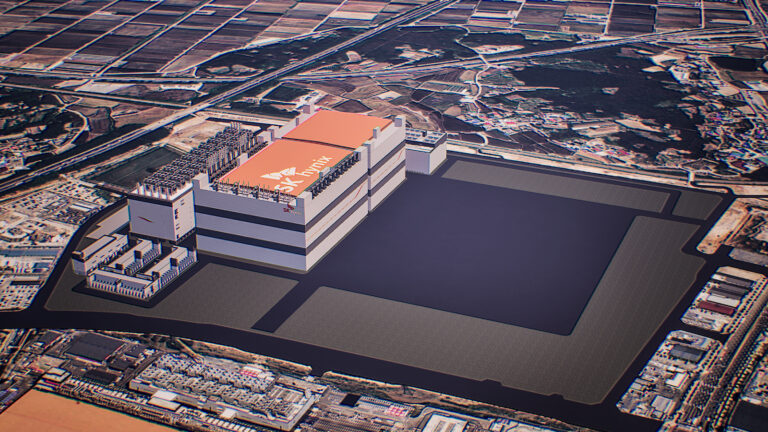
▲ SK hynix Cheongju Campus P&T7 (Artist’s rendering)
SK hynix also plans to accelerate investment to expand NAND production capacity. As part of this initiative, the company will invest KRW 100 trillion in Cheongju. The investment will support construction of new NAND fabs, installation of manufacturing equipment, and expansion of advanced packaging capabilities for HBM back-end processing.
As demand for high-performance memory continues to surge, driven primarily by AI data centers, SK hynix plans to further develop Cheongju into a comprehensive manufacturing hub encompassing NAND, HBM, and advanced packaging.
The Southwestern Cluster to Serve as SK hynix’s Next Manufacturing Hub
While SK hynix continues to expand production capacity in Yongin and Cheongju, memory demand is expected to keep increasing even after both sites reach full-scale operation. To meet future demand without disruption, another large-scale manufacturing hub will be required. Developing a new semiconductor fabrication site—from site selection and infrastructure development to construction—requires many years. For example, it took approximately nine years to develop the Yongin Cluster. In order to meet future demand in time, preparations for the next production base must begin today.
Developing a new mega fab requires not only a large development site but also the supporting infrastructure, including reliable electricity and water supply.
The Southwestern Region offers the potential to secure a large-scale site, while both the central and local governments have demonstrated a strong commitment to developing the necessary infrastructure, including electricity and water supply.
Recognizing that the Southwestern Region is well positioned to meet these requirements, SK hynix plans to invest KRW 400 trillion to develop a new semiconductor cluster. The investment will be carried out in phases, covering land acquisition, fab construction, and the installation of manufacturing equipment.
Large Manufacturing Hubs Require Robust Infrastructure
Large-scale semiconductor clusters can only be successfully developed when supported by the necessary infrastructure. To complete a mega cluster on schedule, sufficient land, electricity, and water resources must all be available. Only when large development sites are complemented by reliable infrastructure can a manufacturing hub operate as intended. SK hynix’s decision to prepare the Southwestern Region as its next production base reflects confidence that these essential conditions can be established there.
The semiconductor industry delivers meaningful results only when corporate investment and industrial infrastructure are aligned. When manufacturing facilities and supporting infrastructure develop in tandem, they create a virtuous cycle that strengthens investment, employment, and industrial competitiveness. Based on this foundation, SK hynix will continue making stable and sustainable investments.
Building the Next Stage of the Global AI Ecosystem Together
SK hynix’s mid-to-long-term investment strategy begins with its responsibility as a global memory leader to respond reliably to rapidly growing AI memory demand. Resolving global memory supply shortages and establishing a stable supply chain are essential foundations for the continued development of the global AI ecosystem.
Having grown on the foundation of its production bases in Icheon and Cheongju, SK hynix is now preparing for its next leap forward by expanding its manufacturing footprint to Yongin and onward to the Southwestern Region. As long as demand continues and the necessary infrastructure is in place, SK hynix will further strengthen its contribution to the advancement of the global AI ecosystem. SK hynix will continue to anticipate and lead market growth through proactive investment based on customers’ long-term demand and future technological developments.
Q&A ——————————————————————-
Q1. What is the overall scale and composition of this mid-to-long-term investment strategy?
SK hynix has established the KRW 1,100 trillion mid-to-long-term investment strategy, consisting of KRW 600 trillion for Yongin, KRW 100 trillion for Cheongju, and KRW 400 trillion for the Southwestern Region. In addition to the ongoing Yongin project and the expanding Cheongju production base, the strategy includes the newly planned Southwestern Cluster as the company’s next major manufacturing hub.
Q2. What prompted SK hynix to develop this mid-to-long-term investment strategy?
As memory demand continues to grow rapidly in the AI era, securing large development sites and the necessary infrastructure—including reliable electricity and water supply—for new semiconductor fabs has become increasingly important. Although SK hynix has accelerated construction of the Yongin Cluster, the company determined that Yongin alone will not be sufficient to meet future demand. Accordingly, SK hynix has evaluated potential locations capable of supporting another large-scale production hub and concluded that the Southwestern Region offers the necessary conditions.
Q3. According to the investment plan, the Yongin Cluster will be completed by 2033. Does that mean the entire KRW 600 trillion investment will also be executed by then?
The year 2033 marks the completion of construction of the fourth fab at the Yongin Cluster, specifically the completion of its first cleanroom. Investments in the remaining cleanrooms, manufacturing facilities, and production equipment will be made in phases in line with market demand. Accordingly, the total investment of KRW 600 trillion will extend beyond 2033.
Q4. Why was the Southwestern region selected? What criteria were used?
The primary criteria were the availability of a sufficiently large site for mega fabs and the ability to secure supporting infrastructure such as electricity and water. Other important considerations included workforce availability, transportation, and overall living conditions. It is not easy to find a location that satisfies all of these requirements. The Southwestern Region offers significant potential for securing a large-scale site, while both central and local governments have demonstrated strong commitment to developing the necessary infrastructure. Specific infrastructure plans will be discussed with the central and local authorities in the future.
Q5. Where exactly is the Southwestern Cluster located?
At this stage, we are announcing our intention to develop the Southwestern Region as the next major production base following Yongin. The specific location will be determined through discussions with the relevant authorities after comprehensive evaluation of land availability, electricity, water, transportation, and other infrastructure requirements. More detailed information on the site will be provided once preparations have been completed.
Q6. What will be the scale, schedule, and scope of the Southwestern Cluster?
The Southwestern Cluster will serve as SK hynix’s next manufacturing base following Icheon, Cheongju, and Yongin, with a primary focus on front-end memory manufacturing. A total of KRW 400 trillion will be invested in phases, covering land acquisition, fab construction, and production equipment. Since site selection and infrastructure development require considerable time, preparations will begin immediately even though investment will be phased over the long term. SK hynix is preparing the project to ensure there is no gap in production capacity following Yongin. The specific investment scale and timeline may vary depending on market demand and will be finalized in stages following approval by the Board of Directors.
Q7. What benefits are expected from the Southwestern Cluster?
Most importantly, it will significantly strengthen SK hynix’s competitiveness by securing additional manufacturing capacity to meet rapidly growing global demand. It is also expected to reinforce long-term partnerships with global customers by providing a more stable and reliable supply base.
Q8. How will investment in Cheongju proceed?
KRW 100 trillion will be invested in Cheongju. The investment will support construction of new NAND fabs, installation of production equipment, and expansion of advanced packaging capabilities for HBM. Detailed schedules and investment plans for the new fabs will be finalized following approval by the Board of Directors.
Q9. How will SK hynix finance this KRW 1,100 trillion investment?
This investment will not be executed all at once but rather in phases over an extended period based on demand visibility. Accordingly, funding will also be secured gradually as investment progresses. Financing will primarily be based on cash flow generated from operations while maintaining flexibility in both the scale and timing of financing in accordance with market conditions and the company’s CapEx Discipline. SK hynix is also exploring various financing options, including collaboration with global partners. Specific financing methods and terms will be determined as investment progresses. Under these principles, the company will continue to pursue stable and sustainable investment.
Q10. Will investment in Icheon be reduced? Will its role as headquarters diminish?
Given continued customer demand, production cannot be reduced at any existing site. Icheon will continue to serve as SK hynix’s headquarters and core hub for R&D and advanced manufacturing technologies. This investment is intended to expand the company’s manufacturing footprint, not replace existing production bases.
Q11. Did SK hynix consult with the central or local governments before making this decision?
This decision was first and foremost driven by the company’s business needs and assessment of its global competitiveness. At the same time, developing a large-scale semiconductor cluster in Korea requires not only extensive land but also national-level infrastructure, including reliable electricity and water supply. Accordingly, SK hynix formulated this investment strategy after comprehensively considering the government’s semiconductor industry development policies, the overall business environment, and future market demand. Beginning today, the company will work closely with the central and local governments on specific infrastructure development plans and permitting procedures.
Q12. Are there plans for additional domestic investments? Is SK hynix considering regions beyond the Southwestern area?
This announcement covers investments in our existing production bases—Yongin and Cheongju—as well as the new Southwestern production hub. As memory demand continues to grow, SK hynix may consider establishing additional production bases wherever market demand and infrastructure conditions are favorable. In particular, since large-scale fabs require stable supplies of electricity and water, future investment decisions will be made from a business perspective while taking into account the commitment and readiness of central and local governments to develop the necessary infrastructure. At this time, however, there are no specific plans to announce additional locations, and future opportunities will be evaluated based on market demand and infrastructure availability.
Q13. Is SK hynix also considering additional overseas investments?
To meet growing demand, SK hynix continuously evaluates opportunities to expand its long-term production capacity. The company applies consistent criteria when making investment decisions, comprehensively assessing factors such as site availability, infrastructure –including reliable supplies of electricity and water– and opportunities for collaboration with customers and partners before selecting the most suitable location.
Locations outside Korea that meet these criteria may also be considered, with future investment decisions made based on market conditions and business feasibility.
Q14. Are customers concerned that products manufactured in the Southwestern region could face logistics delays or quality issues compared with existing production sites?
Semiconductor products are small, lightweight, and high in value, making air transportation the standard method for global logistics. The same quality standards and manufacturing systems are applied across all SK hynix facilities, ensuring consistent quality regardless of production location. In fact, diversifying manufacturing bases into regions with reliable infrastructure is expected to further strengthen overall supply chain resilience.
Q15. Beyond the anchor company, what incentives will encourage materials, components, and equipment suppliers to relocate to the Southwestern region?
Timely collaboration with suppliers is essential for an anchor company like SK hynix. The company will work to create an attractive business environment for suppliers within the Southwestern Cluster by establishing favorable conditions for co-location, enabling partner companies to naturally expand alongside SK hynix.
Q16. Can SK hynix maintain its CapEx Discipline while undertaking investments of this scale?
The investment figures announced today are not intended to be spent all at once but will instead be executed gradually based on demand visibility. SK hynix’s investment principles remain unchanged. The company will continue to verify mid-and-long-term demand through close collaboration with customers and will execute investments sequentially in accordance with its CapEx Discipline.
Q17. Multiple fabs will be built simultaneously, while other domestic semiconductor companies are also making large-scale investments. Will there be difficulties securing construction workers, equipment, or infrastructure?
SK hynix fully recognizes that simultaneous large-scale projects across the semiconductor industry could tighten the supply of construction labor and equipment. To address this, the company plans to stagger cleanroom completion and operational schedules across different fabs, enabling efficient allocation of limited resources and ensuring projects proceed without disruption. Furthermore, these continuous investments are expected to stimulate Korea’s construction industry and related sectors.
Q18. Why does SK hynix believe memory supply will struggle to keep pace with demand?
As semiconductor manufacturing processes become increasingly sophisticated, more production space is required even to manufacture the same output. At the same time, products such as HBM require more wafers to achieve the same memory capacity, and constructing new fabs requires many years. Taken together, these factors make securing sufficient production capacity well in advance a critical competitive advantage.
Q19. Why does HBM require more wafers than conventional DRAM to achieve the same memory capacity?
Even when delivering the same memory capacity, HBM DRAM produces fewer usable dies per wafer than conventional DRAM. This is because Through-Silicon Via (TSV) technology, which vertically connects stacked chips, increases die size. As a result, more wafers are required to produce the same memory capacity. In addition, HBM involves sophisticated chip stacking and packaging processes, further increasing manufacturing complexity. Consequently, as HBM accounts for a larger share of production, substantially greater wafer manufacturing capacity is required to produce the same overall memory volume.