SK hynix continued to deliver solid results in the first quarter of 2026 amid favorable market conditions, once again reaffirming its presence as a leader in AI memory.
In particular, expanded investment in AI servers and rising demand for high-performance memory centered on data centers are being viewed as key factors driving not just a short-term recovery in market conditions, but a structural shift across the memory industry as a whole. As a result, the market is increasingly re-evaluating SK hynix not merely as a memory semiconductor manufacturer, but as a direct beneficiary of the expansion of AI infrastructure.
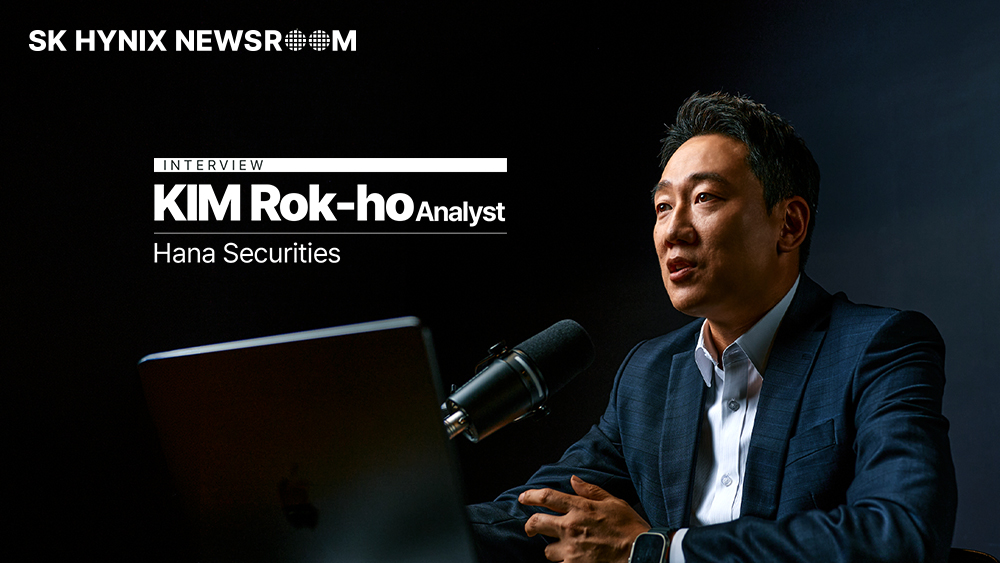
So, what trends are shaping the memory market today? How long can the price strength in DRAM and NAND continue? And what are the key points SK hynix should focus on amid the rapid evolution of the AI ecosystem? We discussed SK hynix’s earnings, industry conditions, and future growth momentum with Rok-ho Kim, research analyst at Hana Securities.
Expansion of the AI Ecosystem Is Positive for Memory Demand
“One point we view particularly positively is that the price increase was not limited to DRAM, but also expanded meaningfully in NAND.”
SK hynix posted solid results in the first quarter, supported by a favorable pricing environment for memory. In particular, while strength in high-value-added DRAM products, including HBM, continued, the NAND market also showed signs of a gradual price recovery, broadening the foundation for earnings improvement.
What stands out is that this improvement is not confined to a specific product category, but is spreading across the overall memory market. In the past, industry conditions and earnings often fluctuated according to demand cycles centered on PCs and mobile devices. Recently, however, demand has been expanding beyond high-capacity server DRAM, driven by AI server investment, to include LPDDR and eSSD, helping to stabilize the company’s portfolio.
Kim expects memory supply to remain limited while demand continues to grow across the memory market, increasing the likelihood that supply-demand conditions will become even tighter toward the second half of 2026. In his view, the spread of AI demand is likely to broaden SK hynix’s business base and serve as a structural driver of improved earnings quality.
Expansion of the AI Ecosystem Is Positive for Memory Demand
Behind these changes lies the rapid evolution of how AI is being used. AI is moving beyond simple LLM-based experiences and expanding into the stages of Agentic AI and Physical AI. In the consumer market, AI has already moved beyond chatbots and is rapidly becoming a productivity tool that supports a wide range of tasks, including document writing, search, coding, and content creation. In the B2B space, the use of AI agents is also increasing, particularly for tasks that require multi-step reasoning, real-time data processing, and long-context retention. This points to a clear trend in which AI is evolving from a simple assistant into a more autonomous system.
As the scope of AI applications expands and the complexity of tasks increases, the amount of computation and data processing required will inevitably rise as well. In particular, these advanced workloads require far more memory resources than simple question-and-answer interactions. As a result, the spread and evolution of AI are expected to lead to an increase in total memory demand.
The outlook for explosive growth in memory demand is also accelerating the development of various memory-efficiency technologies. Technologies such as compression, caching, and model lightweighting may appear, at first glance, to reduce memory usage. In practice, however, they are likely to allow more customers to use AI services at lower cost, thereby increasing overall usage. Rather than simply reducing demand, memory-efficiency technologies lower the barriers to AI adoption and are ultimately expected to contribute to broader AI service adoption and an expansion in total memory demand.
The Standard for Memory Valuation Is Also Changing
The market’s view of SK hynix’s valuation is also changing. In the past, memory companies were often evaluated using a single multiple, as the industry was perceived to be highly cyclical. More recently, however, there has been a growing view that commodity memory and high-value-added businesses centered on HBM should be assessed separately, using approaches such as SOTP* valuation that reflect the characteristics of each business segment.
* Sum-of-the-Parts: a valuation method that calculates a company’s value by summing the value of each business segment.
At the same time, what investors are paying closer attention to now is not simply growth potential, but the sustainability of profitability. Since the market has already reflected much of the expected expansion in AI demand and price increases, the key variable going forward will be how long high profit margins can be maintained. In particular, with DRAM profitability already at elevated levels, additional earnings upside is expected to depend largely on whether NAND profitability improves.
Kim believes that for SK hynix’s share price to move to the next level, the company will need not only solid earnings but also a re-rating of its valuation multiple. If structural factors improve earnings visibility and lead to higher multiples, the market’s valuation framework for SK hynix could also move one step higher.
※ This article does not represent the official position of SK hynix. It is based on an independent personal interview and is separate from the company’s decision-making.