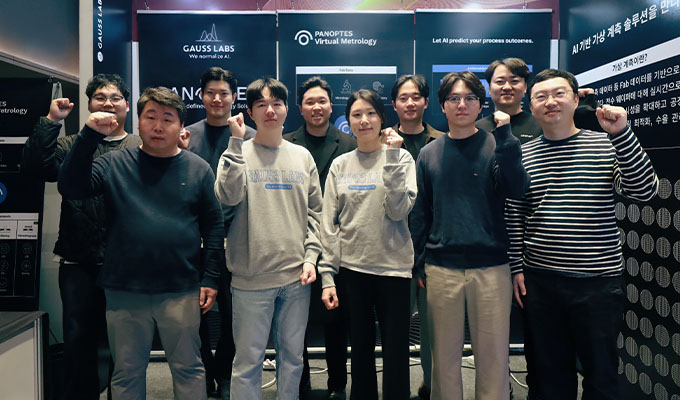
SK hynix will partner with Gauss Labs, an industrial AI startup, to participate in SPIE Advanced Lithography + Patterning 2026 (SPIE AL 2026). At the international conference to be held in San Jose, California, from February 22 to 26, the two companies will share the latest research on AI-based virtual metrology for semiconductor manufacturing processes.

SPIE AL 2026 is an academic conference hosted by SPIE (the Society of Photo-Optical Instrumentation Engineers), one of the world’s most prestigious international societies in the fields of optics and photonics, founded in the United States in 1955.
At this year’s SPIE AL 2026, a wide range of methodologies aimed at improving process efficiency will be presented across areas such as process technologies, materials, and equipment that can be utilized in nanolithography1, as well as metrology, inspection, and process control. Sessions showcasing next-generation patterning technologies, such as computational patterning2, have already begun attracting strong interest.
1Nanolithography: A process for forming ultra-fine patterns at the nanometer scale
2Computational Patterning: A technology that predicts and corrects how circuit patterns will be formed using computer algorithms and simulations before actual wafer etching.
Gauss Labs and SK hynix plan to present a total of two papers in one oral presentation and one poster presentation. SK hynix has worked closely with Gauss Labs to improve metrology3 efficiency in semiconductor manufacturing processes and has used Gauss Labs’ AI-based virtual metrology solution “Panoptes VM (Virtual Metrology)” in its production lines since 2022. The two papers to be presented are based on joint research conducted by members of Gauss Labs and SK hynix using operational data collected from Panoptes VM deployed in actual SK hynix manufacturing environments.
3Metrology: The process of measuring and verifying process results to ensure that each step is performed correctly
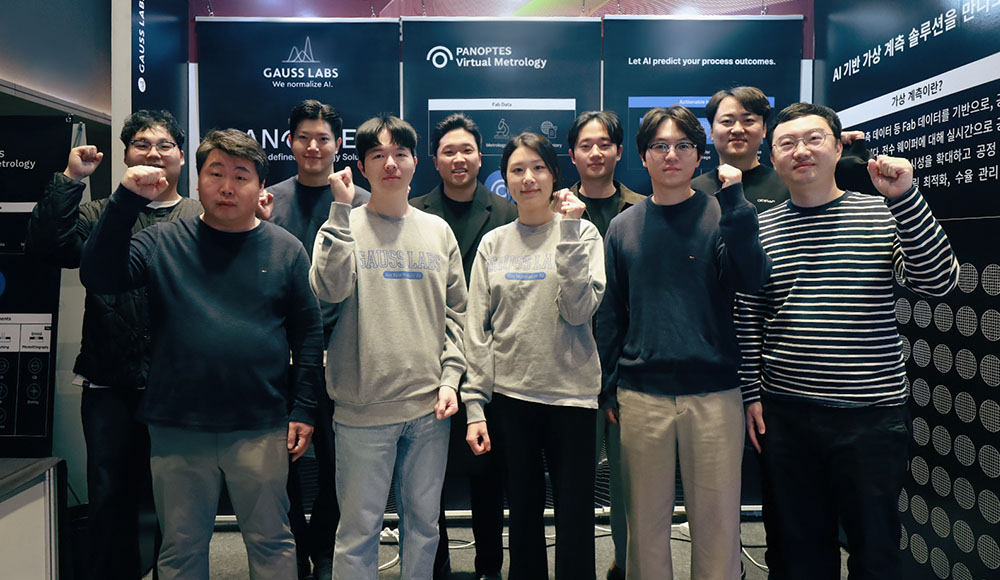
During the oral presentation session on February 23, the paper titled “A Virtual Metrology-Driven Tool-to-Tool Matching4: Toward Early Anomaly Detection and Diagnosis” will be introduced. In this study, Gauss Labs and SK hynix demonstrate with data that Panoptes VM can effectively identify performance differences between equipment that were difficult to analyze previously due to low sampling rates. The paper also presents methods for early detection of equipment anomalies and rapid diagnosis of root causes based on these insights.
4Tool-to-Tool Matching (TTTM): The process of minimizing performance differences when the same process is performed across multiple equipment to ensure consistent results.
In following poster session on February 25, the paper titled “GRACE: A Gradient-Based5 Model-Agnostic Explainability Framework for Photolithography6 Overlay7 Virtual Metrology” will be presented. In this paper, Gauss Labs and SK hynix introduce GRACE, a newly developed framework8 for overlay virtual metrology in photolithography processes. While conventional overlay prediction models focus primarily on improving accuracy and offer limited explainability regarding how individual input variables influence results, GRACE quantitatively evaluates the impact of input variables on predicted outcomes, providing metrics that explain model performance. SK hynix has been applying this framework in its production environment since last year to promptly detect process abnormalities and identify their causes.
5Gradient-based method: A technique that calculates the influence of each input variable on an AI model’s output using gradient values
6Photolithography: A process that uses light to draw semiconductor circuit patterns on a wafer, similar to taking a photograph with a film camera
7Overlay: A technique for measuring how precisely circuit patterns from successive layers are vertically aligned with previous layers when multiple layers are stacked on a wafer.
8Framework: A technical structure that organizes standardized procedures and tools to efficiently develop and implement complex AI models
Mike Young-Han Kim, CEO of Gauss Labs, commented, “The AI-based technologies presented through this joint research with SK hynix are the result of continuous efforts to identify real-world use cases and create added value in semiconductor manufacturing environments even after solution deployment. Moving forward, we will continue to develop new technologies based on our strong partnership and evolve them into standard solutions that span the entire manufacturing ecosystem.”
Paper 1:
A Virtual Metrology-Driven Tool-to-Tool Matching:
Toward Early Anomaly Detection and Diagnosis
Authors:
Inho Park, Taejong Lee, Byunggu Kang, Sangyeop Park, Dohhyung Noh (SK hynix AI Core Technology Team); Dongwoo Kim, Minwoo Jin, Juhak Lee (SK hynix SYLD Tech Team); Danah Kim, Sol Kwon, Seonwoo Lim, Pil Sung Jo (Gauss Labs)
Paper 2:
GRACE: A Gradient-Based Model-Agnostic Explainability
Framework for Photolithography Overlay Virtual Metrology
Authors:
Gunwoong Cho, Jaegyun Jeong, Junhak Lee, Dongsuk Lim (SK hynix Photo Technology Strategy Team); Hoyoung Choi, Wonhui Park, Jae-Han Lee, Yonghyun Kim, Gunwoong Kim, Junghwan Baek, Seungwoo Seo (Gauss Labs)





![[Semiconductor 101] SK hynix Explores How Semiconductors Are Made & How to Build a Career in the Growing Industry](https://d36ae2cxtn9mcr.cloudfront.net/wp-content/uploads/2025/02/10121445/SK-hynix_Semiconductor-101-6-How_Thumbnail-680x400-1.png)