From accelerating drug development pipelines to advancing autonomous vehicle performance and strengthening financial security, AI is driving paradigm shifts across industries. As AI rapidly reshapes daily life across work, education, homelife and travel, understanding this changing ecosystem is essential for navigating the AI era. This final part of the “Exploring the AI Ecosystem” series looks at what the future holds for the AI industry.
As AI continues to evolve, the industry is gearing up for its next phase of transformation. According to the UN Conference on Trade and Development’s Technology and Innovation Report 2025, the global AI market is projected to grow from USD 189 billion in 2023 to USD 4.8 trillion by 2033 — a 25-fold increase within a decade. This rapid market evolution is intensifying competition, which in turn is accelerating AI-driven innovation.
This final episode of the Exploring the AI Ecosystem series looks at key future trends of the AI industry and SK hynix’s vision as it looks to become a full-stack AI memory provider.
Future of the AI Industry
Technological convergence is one of the key concepts defining the future of the AI industry. The integration of AI with industries such as biotechnology, robotics, and autonomous driving has led to the creation of entirely new ecosystems. One notable example of the convergence between AI and biotechnology is Google DeepMind’s AlphaFold, an AI model designed to predict protein structures, which earned its developers the 2024 Nobel Prize in Chemistry.

The future of the AI industry is expected to be guided by three types of AI which embrace technological convergence: physical, agentic and multimodal. NVIDIA CEO Jensen Huang believes physical AI, which enables autonomous systems such as robots, autonomous vehicles, and smart spaces to operate in the physical world, is the final stage of AI. Going forward, autonomous mobile robots and humanoid robots such as Tesla’s Optimus and Boston Dynamics’ Atlas, which integrate AI and robotics, are set to expand their applications beyond manufacturing to healthcare and households.
Meanwhile, agentic AI is rapidly developing. Unlike generative AI, which produces text, images, and code based on user input, agentic AI represents the next evolutionary step by enabling autonomous decision-making and goal-driven actions with minimal human involvement. As agentic AI can independently handle complex tasks such as customer interactions, code generation, and IT security automation, companies including OpenAI, Google and NVIDIA are scaling R&D in this field.
Another type of AI on the rise is multimodal AI, which can process and integrate information from various types of data including text, images, audio, and videos. Just as humans use information from multiple senses, multimodal AI combines data from diverse sources to perform more sophisticated tasks. Examples include analyzing medical imaging with patient records and enabling autonomous cars to make decisions by synthesizing visual information from cameras and sensor data. As AI models such as Google’s Gemini and OpenAI’s DALL·E 2 continue to evolve, multimodal processing features are set to become increasingly sophisticated.
Amidst this technological and industrial evolution which has led to a significant rise in computational demands, there is a growing focus on the efficiency and speed of data processing.
Exponential Growth of AI Infrastructure and Memory Industry
AI’s development is driving investment in infrastructure, with a particular focus on data centers and GPU production. In 2025, the global “big four” tech companies — Meta, Amazon, Alphabet and Microsoft — are expected to invest USD 320 billion in AI technologies and infrastructure.

Demand for AI accelerators is also expected to surge. The global GPU market is projected to grow from USD 61.58 billion in 2024 to USD 461.02 billion by 2032, according to Fortune Business Insights. The growth of the AI market is also expected to be driven by memory, which support powerful processors. The World Semiconductor Trade Statistics (WSTS) has forecast that the semiconductor memory market will grow by 17.8% in 2026, fueled by rising demand for AI chips. As AI continues to rapidly evolve, the memory market is becoming increasingly vital for AI infrastructure.
SK hynix’s Vision and Strategy

SK hynix is continuing to innovate in the AI era as it looks to fulfill its vision of becoming a full-stack AI memory provider. As an AI memory provider, the company is committed to building its brand portfolio which spans semiconductor memory technologies, products, solutions and services. To realize its plans, SK hynix will strengthen its technological leadership, invest in both talent and research development, and expand its global partnership ecosystem.
SK hynix’s status as the global AI memory leader is backed by its technological excellence. In March 2025, SK hynix shipped the world’s first 12-layer HBM4 samples to major customers and is preparing mass production for the second half of the year, solidifying its HBM leadership. As demand for customized AI chips tailored to the needs of major tech firms continues to grow, SK hynix is proactively addressing market demand with custom HBM alongside R&D efforts.
In addition, SK hynix is ramping up development of next-generation memory solutions optimized for various environments including data centers and on-device AI. Key areas of research include eSSDs1 optimized for processing and storing large-scale data; PIM2, which integrates computational capabilities into memory; ZUFS3, a NAND solution for on-device AI; and neuromorphic computing4, which enhances efficiency by mimicking human brain structures. Advancements in multi-purpose, high-performance memory solutions will unlock new possibilities for AI and maximize its potential.
1Enterprise solid-state drive (eSSD): An enterprise-grade SSD used in servers and data centers.
2Processing-In-Memory (PIM): A next-generation memory technology that integrates computational capabilities into memory, addressing data movement bottlenecks in memory and processors while demonstrating significantly faster speed and improved performance.
3Zoned Universal Flash Storage (ZUFS): An extended specification of UFS, a high-speed flash memory storage specification for mobile devices such as smartphones and tablets, with improved data management efficiency. It applies Zoned Storage technology, which stores and manages similar data types within the same zone, optimizing data transmission between the operating system (OS) and storage devices.
4Neuromorphic computing: A system inspired by the human brain’s parallel data processing between neurons and synapses, replacing the traditional sequential data-fetching method.
SK hynix has also made large-scale investments to strengthen its technological leadership. This includes a commitment in 2019 to spend KRW 120 trillion (USD 86.2 billion) on building facilities in the Yongin Semiconductor Cluster and KRW 20 trillion (USD 14.3 billion) for the M15X fab in Cheongju, which will mass produce DRAM following its completion in November 2025. The company will also invest an estimated USD 3.9 billion in an advanced packaging plant in Indiana, the U.S., which is scheduled to produce next-generation HBM from the second half of 2028.
In addition to its technological developments and investments, SK hynix’s “one-team spirit” has played a key role in its journey to becoming the AI memory leader. The company’s competitive advantage today is rooted in the exceptional talent of its people, all working toward a shared vision. Going forward, SK hynix is committed to investing in talent acquisition and skill development, grounded in the belief that true core competitiveness in the AI era lies in its people.
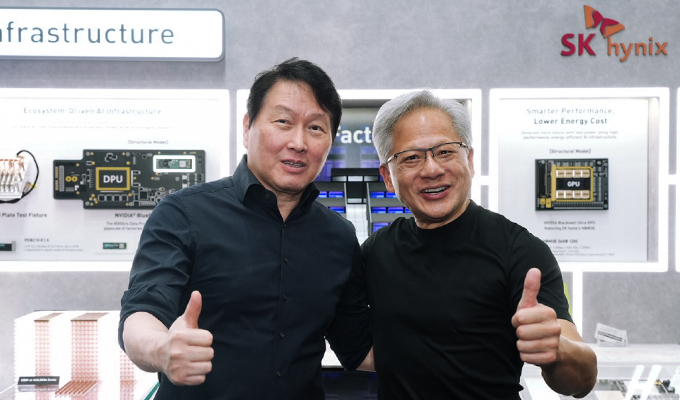
Finally, as the sustainability of the AI ecosystem relies heavily on value chain collaboration, SK hynix is committed to continuously expanding and strengthening its partnerships with global tech leaders. By working closely with key partners such as NVIDIA and TSMC, SK hynix has established itself as an essential player in the AI ecosystem.
Leading the Future of the AI Ecosystem
“The best way to predict the future is to create it.” These words from renowned management consultant Peter Drucker resonate deeply with SK hynix’s approach to navigating the rapidly evolving AI landscape. Committed to shaping the future of AI memory, SK hynix is driving innovation with world-class technologies and positioning itself as a full-stack AI memory provider dedicated to defining the future of the AI ecosystem.