SK Group Chairman Chey Tae-won visited Taipei for GTC Taipei 2026, just months after participating in GTC 2026 in San Jose this past March. By once again positioning himself at the forefront of AI innovation, Chairman Chey further solidified SK hynix’s partnership with NVIDIA, demonstrating his commitment to deepening collaboration with the world’s leading technology companies and taking a leading role in shaping the global AI ecosystem.
Witnessing NVIDIA’s Technology Innovation Roadmap Firsthand
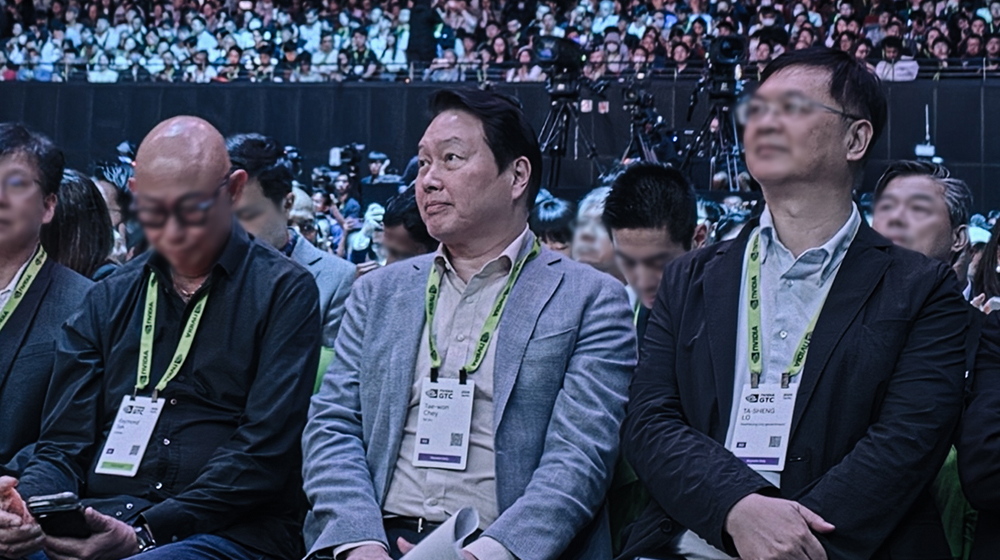
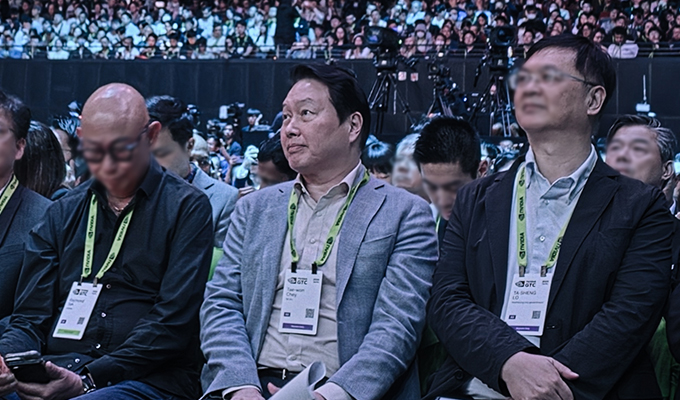
Chairman Chey attended the keynote address by NVIDIA CEO Jensen Huang alongside SK hynix President & CEO Kwak Noh-jung. Huang reviewed the evolution of GPU-based accelerated computing and key AI innovations, and introduced the mass production roadmap for Vera Rubin — the next-generation platform designed to accelerate this wave of innovation — along with updates on collaboration with Asia-Pacific partners. He also shared the progress of partnerships with global automakers and manufacturers across physical AI platforms — including autonomous driving and industrial robotics — and presented a blueprint for building an integrated ecosystem with partners across AI factories and open-source AI models.
Chairman Chey followed the session closely, using the opportunity to assess firsthand the role SK hynix must play as the AI landscape evolves at an unprecedented pace. The visit reinforced the company’s direction: to strengthen partnerships with key customers through HBM1 technology while proactively securing next-generation memory solutions. It also solidified SK hynix’s identity as an innovative partner co-building the architecture of the AI era.
1HBM (High Bandwidth Memory): A high-performance memory solution that vertically stacks multiple DRAM dies to dramatically boost capacity and data throughput. HBM has evolved through six generations: HBM → HBM2 → HBM2E → HBM3 → HBM3E → HBM4.
A Partnership Forged Through Meeting After Meeting – Reaffirmed in Taipei
The engagements between Chairman Chey and Jensen Huang this year have been particularly significant. In February, the two leaders met in Silicon Valley for what became widely known as the “chimaek summit,” where they held in-depth discussions on HBM4 and broader AI chip collaboration. They reconvened at GTC 2026 in San Jose in March to further refine their joint technology roadmap. GTC Taipei extended that dialogue, giving both sides another opportunity to align on the shared AI infrastructure vision they have been building together.
 SK Group Chairman Chey Tae-won (left) and NVIDIA CEO Jensen Huang (right) at their “chimaek summit” meeting in Silicon Valley
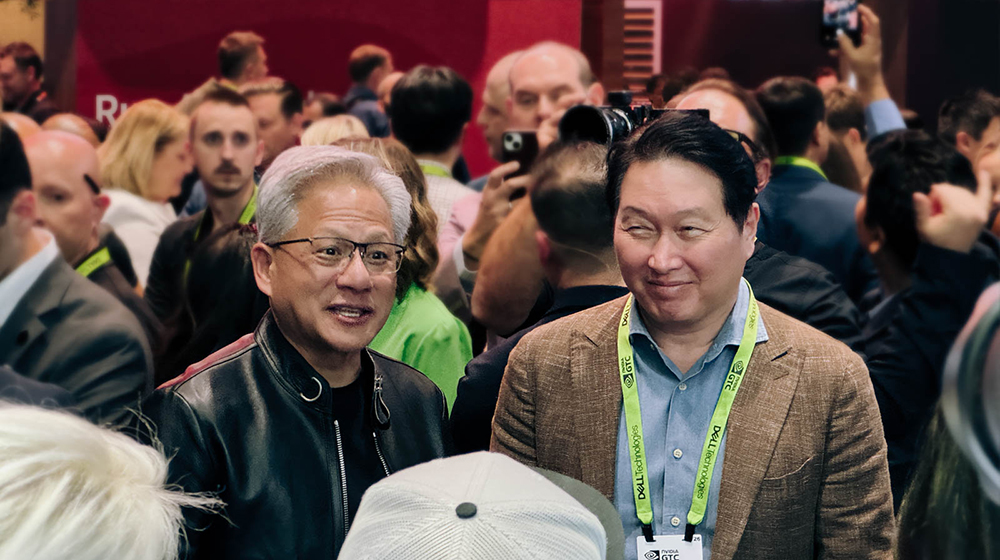
What started as a supplier-customer relationship has evolved into a one-team partnership at the heart of AI infrastructure. Chairman Chey’s attendance at the keynote underscored the trajectory of the partnership— two companies leading their respective domains while jointly completing a single AI architecture.
Leading the AI Ecosystem as a ‘Full-Stack AI Memory Creator’
During his business trip to Taiwan, Chairman Chey will personally introduce SK hynix’s evolved strategic vision to key partners. The company is moving beyond a role of conventional HBM supplier — redefining its role as a Full-Stack AI Memory Creator that participates from the earliest stages of a customer’s AI system design to co-develop optimized, end-to-end solutions. At the center of this approach is cHBM (Customized HBM), a strategy that extends across DRAM and NAND to elevate both the performance and efficiency of AI systems.
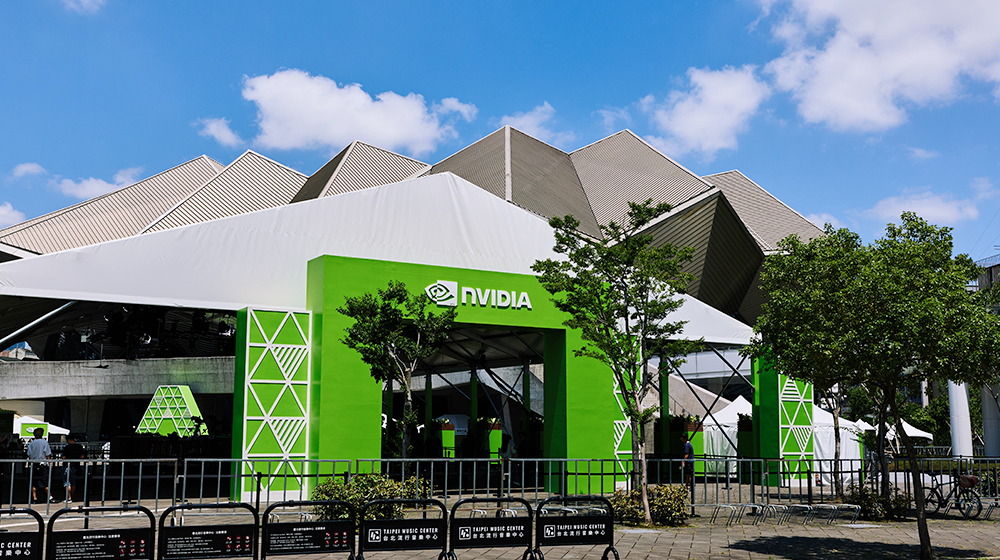
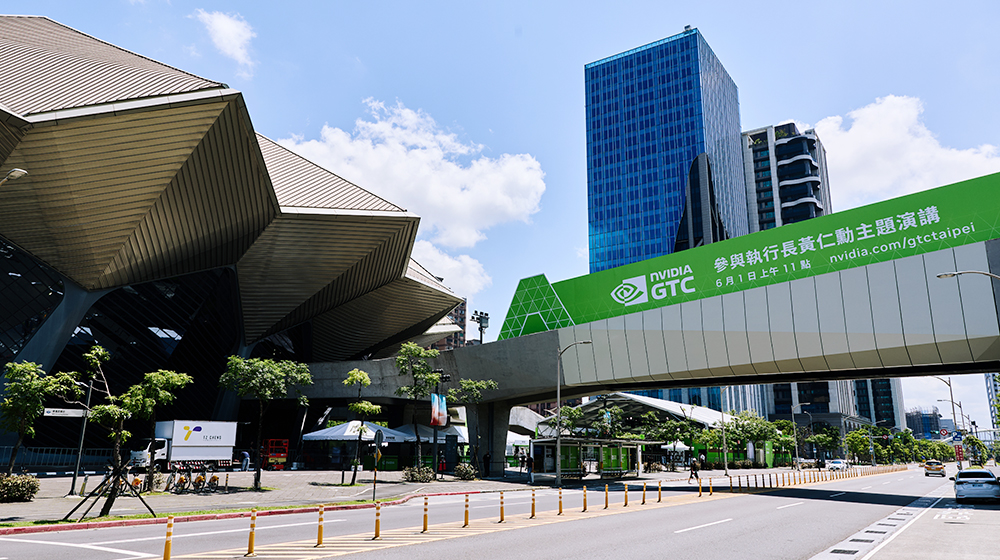
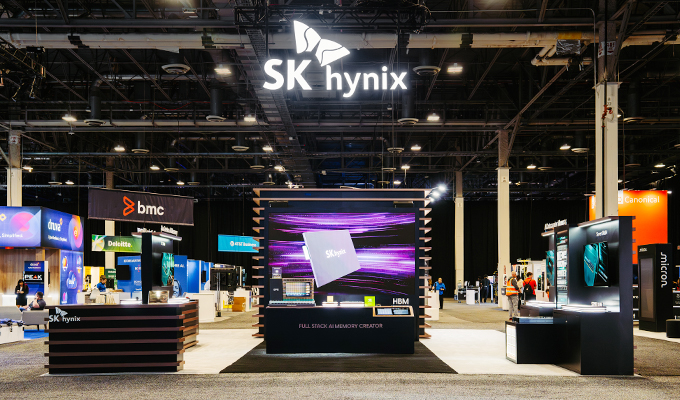
Overall view of GTC Taipei 2026
SK hynix is also pushing beyond the structural limitations of conventional memory architecture by integrating memory and logic technologies. This innovation — first reflected in HBM4 — will extend beyond HBM to HBF2 and 3D Stacked DRAM on Logic3, positioning SK hynix to proactively meet the demands of next-generation AI architectures.
2HBF (High Bandwidth Flash): A next-generation NAND solution designed for high-speed data transfer to handle large-scale AI workloads such as KV cache processing. Like HBM, it incorporates logic process technology into the base die to maximize performance.
33D Stacked DRAM on Logic: A cutting-edge stacking technology that vertically integrates DRAM directly onto logic semiconductors such as SoCs. By dramatically expanding I/O bandwidth while minimizing latency and improving power and space efficiency, it is especially well-suited for on-device AI applications.
As AI becomes foundational infrastructure across every industry, the memory solutions powering it grow increasingly critical. Chairman Chey’s presence in Taipei made one thing clear: SK hynix is not merely enabling the AI era — it is actively co-creating it alongside NVIDIA.