The focus of AI infrastructure competition is shifting. Larger models and faster compute engines remain important, but for AI systems to scale reliably across real-world services and industrial environments, it is becoming equally important to determine where data resides, which memory layer processes it, and how efficiently it can be retrieved when needed.
This shift is also changing the role of memory companies. In the past, their primary role was to reliably supply products that customers required. In the AI era, however, their role as technology partners is expanding to include a deeper understanding of customers’ AI chips, system architectures, workloads, power requirements, and thermal designs.
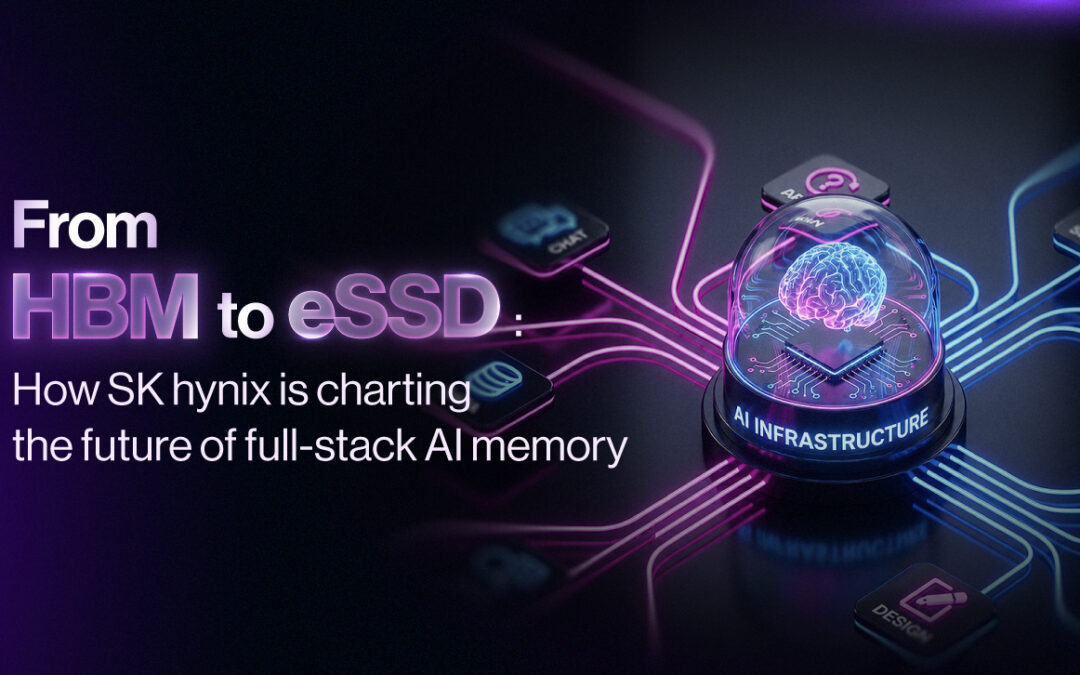
SK hynix’s vision of becoming a full-stack AI memory creator reflects this transition. Building on its leadership in HBM, the company is extending its AI memory capabilities into AI-DRAM and AI-NAND while connecting product development with customer co-design and production and packaging infrastructure. Through this approach, SK hynix is strengthening its product portfolio, customer collaboration, and investment foundation to further advance its full-stack AI memory capabilities.
HBM leadership: The starting point of SK hynix’s AI memory portfolio
SK hynix’s AI memory strategy begins with its leadership in HBM. Positioned close to AI accelerators, HBM delivers ultra-high-bandwidth data to support large-scale training and high-performance inference. As AI models grow and the amount of data to be processed increases, the ability to provide the data required by computing engines at the right time becomes a key factor in overall system efficiency.
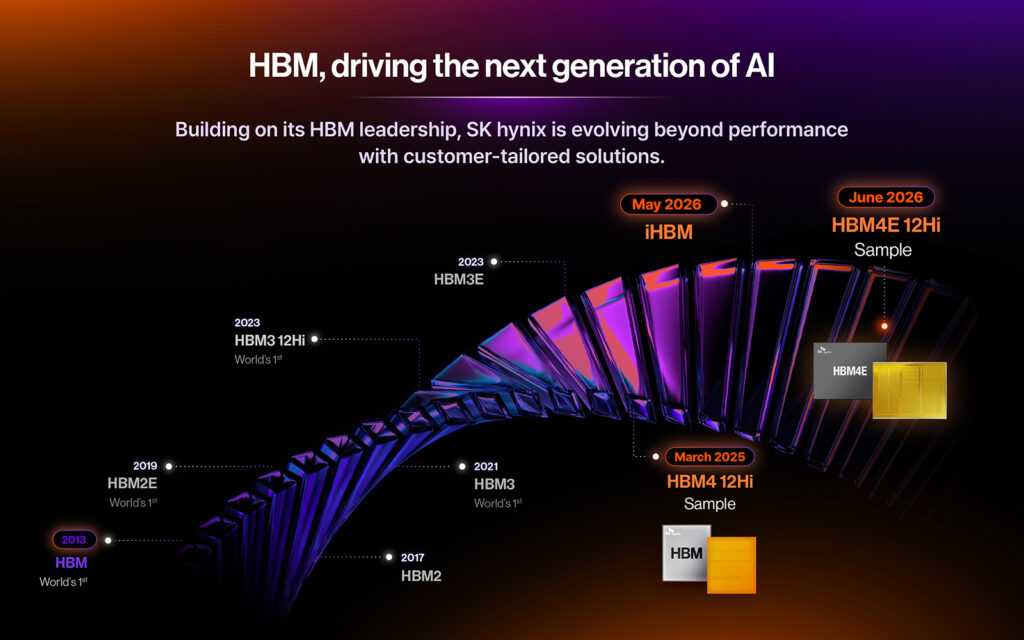
Based on the technological capabilities it has built in the HBM market, SK hynix has continued to strengthen its position in AI memory. The company announced both the completion of HBM4 development and preparations for its mass production and also showcased its AI memory portfolio centered on HBM3E and HBM4 at major global technology events. HBM4 is a next-generation product designed to address the higher bandwidth and power efficiency requirements of high-performance AI systems. [Related article]
The role of the logic die1 is becoming particularly important in HBM4. HBM4 is being developed in a direction that enhances base die performance, improving connectivity between the HBM stack and logic chips while reducing power consumption. Through its collaboration with TSMC, SK hynix is applying advanced logic process technology to the base die2 starting with HBM4, expanding the basis of HBM competitiveness beyond bandwidth to include logic dies, packaging, power efficiency, and customer system optimization.
1Logic die: A term emphasizing the base die’s functional role, including control logic and input/output.
2Base die: A semiconductor die located at the bottom of an HBM stack that handles data input/output and control functions between multiple DRAM dies and external logic chips. Starting with HBM4, the performance and process technology of the base die are becoming increasingly important factors for bandwidth, power efficiency, and customer system optimization.
HBM technology is also expanding beyond bandwidth and capacity improvements to address stability and thermal management in high-density, high-power environments. SK hynix’s iHBM3 solution is a thermal management technology concept aimed at next-generation HBM products, with a focus on improving operational stability and efficiency in high-density, high-bandwidth environments. This shows that the evolution of HBM now extends beyond product performance to include packaging, power, and thermal management at the system level. [Related article]
3iHBM: SK hynix’s thermal management solution concept for next-generation HBM products.
Recently, HBM has been evolving beyond performance advancement to address customer system optimization. In its product roadmap beyond HBM4, SK hynix has identified HBM4E4 and custom HBM5 as key directions. Custom HBM is an approach that optimizes the base die and system structure of HBM according to customers’ AI chip and workload requirements. As the needs of the AI market shift beyond general performance improvements toward inference efficiency and total cost of ownership (TCO)6 optimization, HBM is also evolving into a customized solution tailored to customer systems.
4HBM4E: An extended product generation following HBM4, targeting the bandwidth, capacity, and power efficiency required by next-generation AI systems.
5Custom HBM: Customized HBM that optimizes the base die, packaging structure, and other elements according to customers’ AI chip architectures, workloads, and power and thermal design requirements.
6Total cost of ownership (TCO): A concept that includes not only the cost of adopting a product, but also costs incurred throughout its lifecycle, such as power, operation, and maintenance.
As ever, HBM remains the foundational cornerstone of SK hynix’s AI memory portfolio. However, as AI infrastructure becomes more advanced, HBM needs to be understood not as a standalone product, but as one layer within a broader memory hierarchy that connects system memory with NAND-based storage.
AI-DRAM: Extending HBM leadership to system memory
AI infrastructure does not operate on accelerators alone. In AI servers, data centers, AI PCs, and on-device AI environments, CPUs, AI accelerators, networks, storage, and system memory must work together within a singular architecture. In this structure, AI-DRAM supports performance across servers and overall systems.
SK hynix is extending the technological capabilities that have built HBM into AI-DRAM. SOCAMM2,7 GDDR7, DDR5, and LPDDR are part of a product lineup that supports the system memory performance and power efficiency required for AI servers, high-performance computing, data centers, and on-device AI environments.
7Small Outline Compression Attached Memory Module (SOCAMM2): An AI server-optimized memory module based on low-power DRAM. SK hynix previously announced the mass production of 192GB SOCAMM2 using 1cnm LPDDR5X.
The development direction of AI-DRAM goes beyond improving the performance of conventional DRAM. It is becoming more specialized across low-power, high-performance products that improve data center operating efficiency and reduce TCO, high-bandwidth products optimized for AI servers and accelerated systems, and low-power mobile memory suited for on-device AI. SK hynix’s segmentation of its product lineup under the AI-DRAM concept reflects this trend.
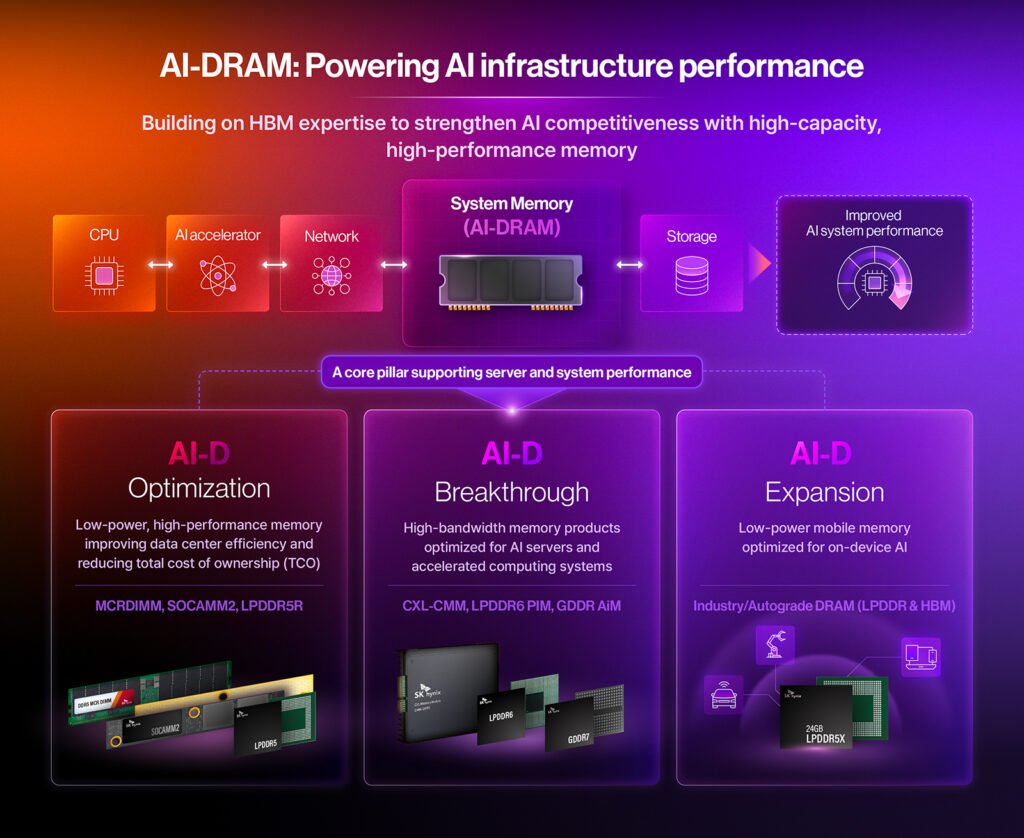
SOCAMM2 is one of the representative products designed to improve memory performance in AI servers. Responding to demand for higher-performance memory in AI servers, SK hynix has begun mass production of 192GB SOCAMM2, utilizing 1cnm LPDDR5X low-power DRAM. Designed to improve the power and space efficiency of server memory modules, SOCAMM2 illustrates how AI server memory configurations are changing. [Related article]
DDR5 also plays an important role in system memory. Through its server DDR5 products, SK hynix supports the speed, power efficiency, and system stability required by AI servers and data center environments. As AI workloads expand beyond servers and data centers into a wider range of computing environments, the role of system memory alongside HBM continues to grow.
GDDR7 sees broader use in high-performance graphics and compute environments. In areas that require large-scale data processing, such as AI, high-performance computing, graphics, and autonomous driving, memory with high speed and power efficiency is essential. LPDDR also plays an important role in on-device AI, mobile, and edge environments. As AI functions expand from the cloud to personal devices and connected devices, low-power DRAM that can deliver performance within limited power and space constraints becomes increasingly important. As AI workloads expand beyond servers and data centers into a broader range of applications, SK hynix continues to advance next-generation ultra-high-capacity, high-performance memory technologies, including PIM and CXL. These innovations provide the foundation for meeting growing demand for high-performance DRAM in emerging AI applications such as robotics, mobility, and industrial automation.
AI-NAND: A storage axis for data-centric AI
As AI expands from training to inference and services, the role of NAND is also growing. AI services continuously generate and utilize user requests, contextual data, search data, model-related data, and application data. In services that require agentic AI and long-context processing in particular, the process of storing, retrieving, and reusing data affects system performance.
SK hynix’s AI-NAND strategy responds to this data-centric AI environment. As the AI inference market grows, demand is also increasing for NAND that can process large volumes of data quickly and efficiently. AI-NAND provides a foundation for storing large-scale data reliably across a broader data layer and accessing it quickly when needed. SK hynix presents the direction of AI-NAND across three dimensions: performance, bandwidth, and density.
First, AI-N Performance (AIN-P)8 delivers higher input/output performance with high-performance SSDs designed around small chunk sizes.9
This supports the fast data access required for inference services and data-centric workloads. AI-N Bandwidth (AIN-B)8 focuses on strengthening high-bandwidth characteristics so that NAND can be used together with HBM, with High Bandwidth Flash (HBF)10 as a representative example. AI-N Density (AIN-D)8 focuses on improving capacity and cost efficiency based on QLC11 NAND and SSDs, with an emphasis on securing storage density and price competitiveness that can compete with HDDs in data center environments.
8AIN-P, AIN-B, AIN-D: SK hynix’s direction for AI-NAND. AIN-P focuses on performance, AIN-B on bandwidth, and AIN-D on density and cost efficiency.
9Chunk size: The amount of data that a storage system processes at once when reading or writing data. Smaller chunk sizes are advantageous for AI workloads that require more granular data access as they can help improve input/output efficiency.
10High Bandwidth Flash (HBF): A next-generation NAND-based technology, considered a new memory layer between HBM and SSDs.
11Quad-level cell (QLC): A technology that stores four bits of data in a single NAND cell, making it advantageous for implementing high-capacity storage.
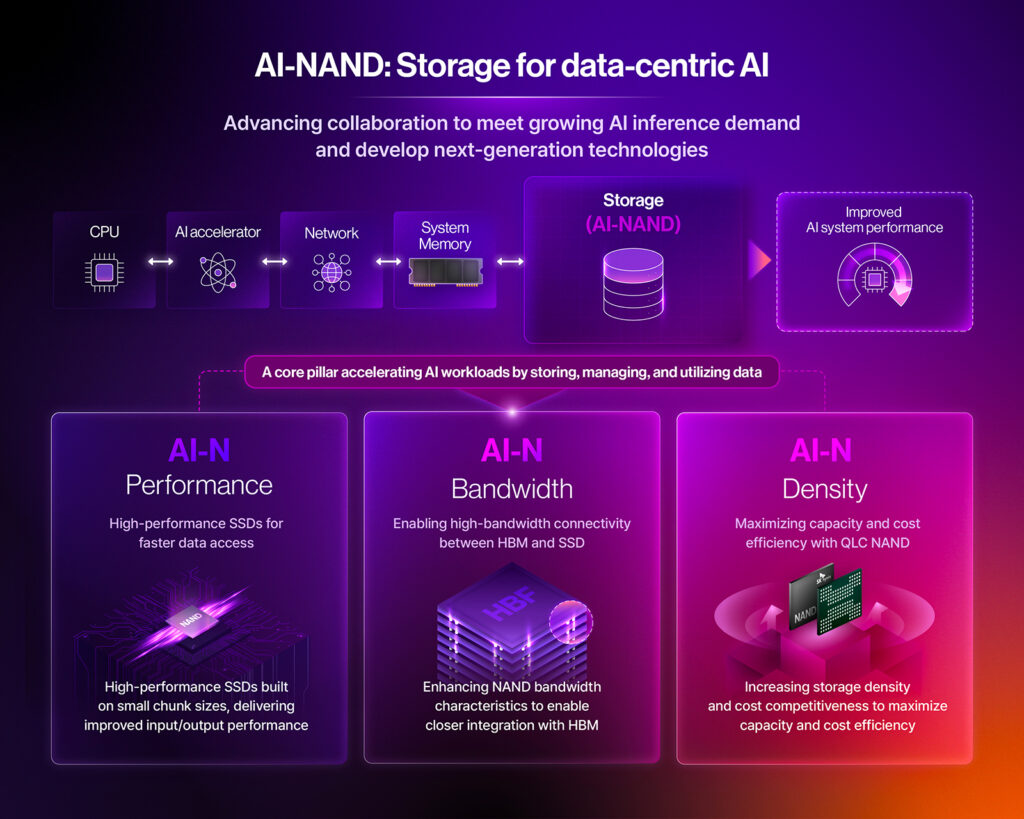
Among these, the 245TB high-capacity QLC-based storage solution and next-generation high-performance storage technologies serve as concrete examples of SK hynix’s AI-NAND strategy for addressing the storage and access requirements of data center and enterprise AI environments. QLC can store more data in a single cell, making it suitable for high-capacity storage, while SK hynix’s mass production of 321-layer QLC NAND is linked to rising demand for large-scale data in AI data centers and enterprise environments.
HBF is also drawing attention as a next-generation storage technology for the AI inference era. Positioned as a new memory layer between HBM and SSDs, HBF is being discussed as a way to improve the efficiency of data processing for large-scale computation data and KV caches12 generated during AI inference. SK hynix is also participating in efforts to build the HBF ecosystem through global standardization collaboration. [Related article]
12KV cache: A technology that stores and reuses previously generated key and value vectors to reduce the inefficiency of repeating earlier calculations.
AI-NAND is evolving beyond simple storage to improve data accessibility and scalability in AI infrastructure. While HBM provides ultra-high bandwidth close to compute and AI-DRAM supports the system memory domain, AI-NAND handles large-scale data storage and utilization, forming a key pillar of the full-stack AI memory portfolio.
AI memory solutions designed together with customers
SK hynix’s strategy is not limited to expanding its product portfolio. AI companies and cloud service providers require memory solutions tailored to their AI chips, system architectures, and service objectives. As a result, the role of memory companies is expanding beyond supplying finished products to become technology partners that understand customer system requirements and engage in discussions from the initial design stage.
Co-design involves more than product specifications. To realize the performance and efficiency required in actual system environments, AI chip architectures, memory bandwidth, capacity, packaging methods, power efficiency, thermal management, and data movement paths must be reviewed in advance together with customers. High-performance memory such as HBM is closely linked with AI chips, packaging structures, power design, and thermal management.
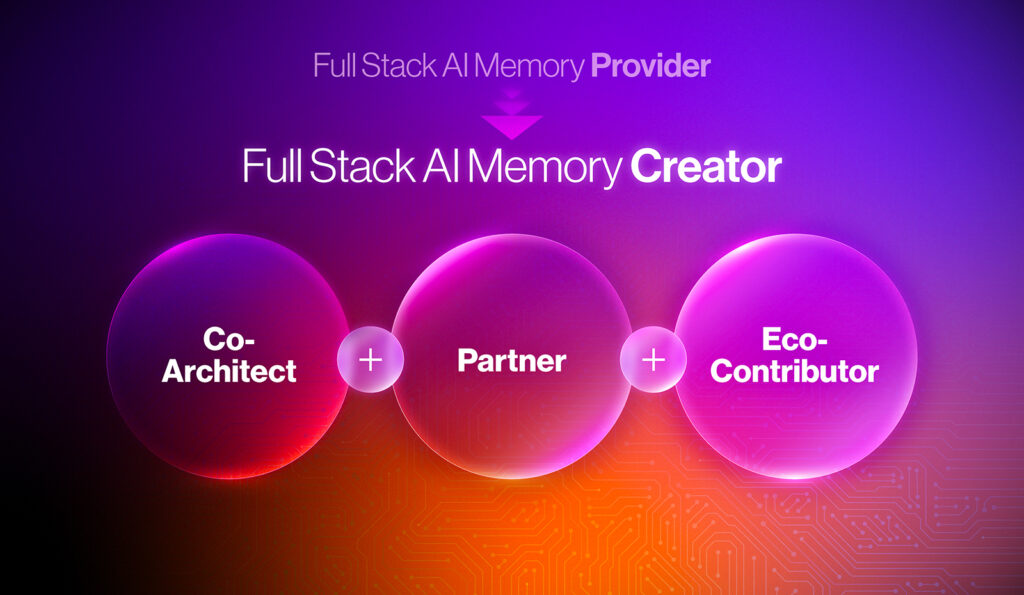
This type of collaboration model is also aligned with the vision of becoming a full-stack AI memory creator presented at SK AI Summit 2025. At the event, SK hynix shared its direction to expand its role from merely a “provider” that supplies the products customers need at the right time to a “creator” that works with customers and partners to solve challenges.
SK hynix is also strengthening its organizational structure and research foundation to respond more closely to changes in the AI ecosystem. Its plan to establish a U.S.-based AI company is a step toward expanding opportunities for AI system-level optimization and collaboration within the data center ecosystem. Based on its global research capabilities, the company is also deepening its understanding of computing systems and exploring next-generation memory solutions suited to customer workloads and system architectures. [Related article]
The strengthening of this organizational and research foundation shows that the role of memory companies is expanding beyond product supply to defining and solving customer challenges together. While each product lineup serves as an important technological foundation, collaboration from the initial design stage is also necessary to realize performance and efficiency within customer systems.
SK hynix’s recently announced multi-year technology partnership with NVIDIA also reflects this shift. The two companies plan to jointly develop next-generation memory for AI factories and expand memory development collaboration aligned with NVIDIA’s AI infrastructure roadmap. Competition for AI memory is moving beyond product supply toward a model that considers customer system roadmaps as well as development and manufacturing environments. [Related article]
Production and packaging infrastructure: The foundation for execution
However, full-stack AI memory creator capabilities cannot be completed through product roadmaps and customer collaboration alone. In an environment where demand for AI memory is growing rapidly, manufacturing and packaging infrastructure capable of reliably producing and supplying high-performance products is also critical.
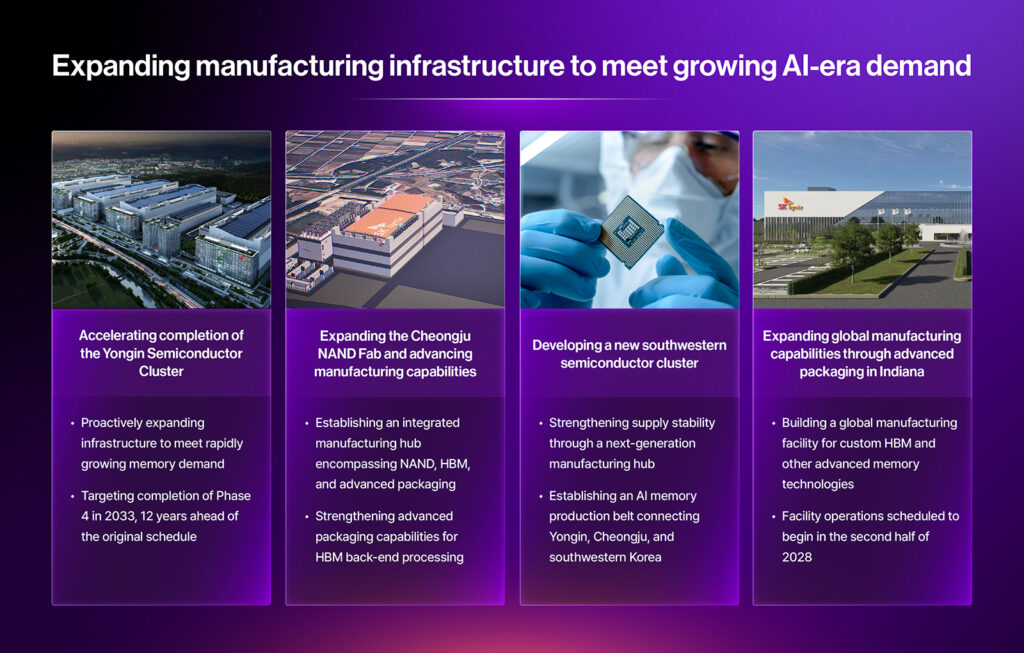
To meet growing demand for high-performance AI memory, including HBM, SK hynix is expanding its production and packaging infrastructure. Investments in the Yongin Semiconductor Cluster, Cheongju NAND FAB, and southwestern Korea can be viewed as key foundations for strengthening SK hynix’s manufacturing base in Korea. Together with its advanced packaging facility in Indiana, U.S., SK hynix is further expanding the foundation needed to strengthen its AI memory production capabilities and supply stability.
The Yongin Semiconductor Cluster is a core site for securing a long-term memory production foundation. Cheongju M15X is being developed as a production hub optimized for next-generation DRAM, such as HBM, while Cheongju P&T7 is being established as an advanced packaging fab dedicated to AI memory products, including HBM. The southwestern production belt expands SK hynix’s domestic manufacturing base by connecting Yongin and Cheongju, reinforcing the company’s long-term strategy to meet growing global demand for high-performance memory as AI adoption continues to expand. The advanced packaging facility in Indiana, U.S. will strengthen packaging and R&D capabilities for AI products and accelerate collaboration with customers in North America. [Related article]
AI memory is an area where high-performance DRAM and NAND, advanced packaging, and customized solutions are closely connected. HBM and next-generation high-performance memory require packaging technology and production stability, while high-capacity storage products require a stable supply foundation aligned with data center demand.
SK hynix’s simultaneous investment in production infrastructure and packaging is not simply an expansion of facilities. It is a foundation upon which to reliably supply its AI memory portfolio in line with market demand and respond to the pace of customers’ AI system development. At the same time, it is also a process of strengthening fundamental competitiveness by advancing process scaling, advanced packaging, automation, and smart factories, as well as quality and reliability.
Charting the path toward becoming a full-stack AI memory creator
SK hynix’s AI memory strategy is built on four key pillars. The first is its leadership in HBM technologies that addresses the growing demands of next-generation AI infrastructure.
The second is an AI-DRAM portfolio that extends across SOCAMM2, GDDR7, and DDR5. The third is an AI-NAND portfolio that includes 245TB QLC-based high-capacity storage and next-generation high-performance storage technologies. The fourth is an execution framework that connects product competitiveness to real-world AI systems through customer co-design, manufacturing capabilities, and advanced packaging infrastructure.
Together, these four pillars turn the vision of becoming a full-stack AI memory creator into a clear execution strategy. Through a portfolio spanning HBM, AI-DRAM, and AI-NAND, collaboration across the global AI ecosystem, and continued investment in manufacturing and advanced packaging, SK hynix is building the foundation for next-generation AI systems.
As AI infrastructure expands across industries and real-world services, customers require AI memory solutions — not just individual memory products — that are designed around specific system architectures and workloads while ensuring reliable, scalable supply. Building on its full-stack AI memory capabilities, SK hynix will continue working alongside customers to build AI systems that are more efficient, scalable, and optimized for production environments.